
SIE Study Plan
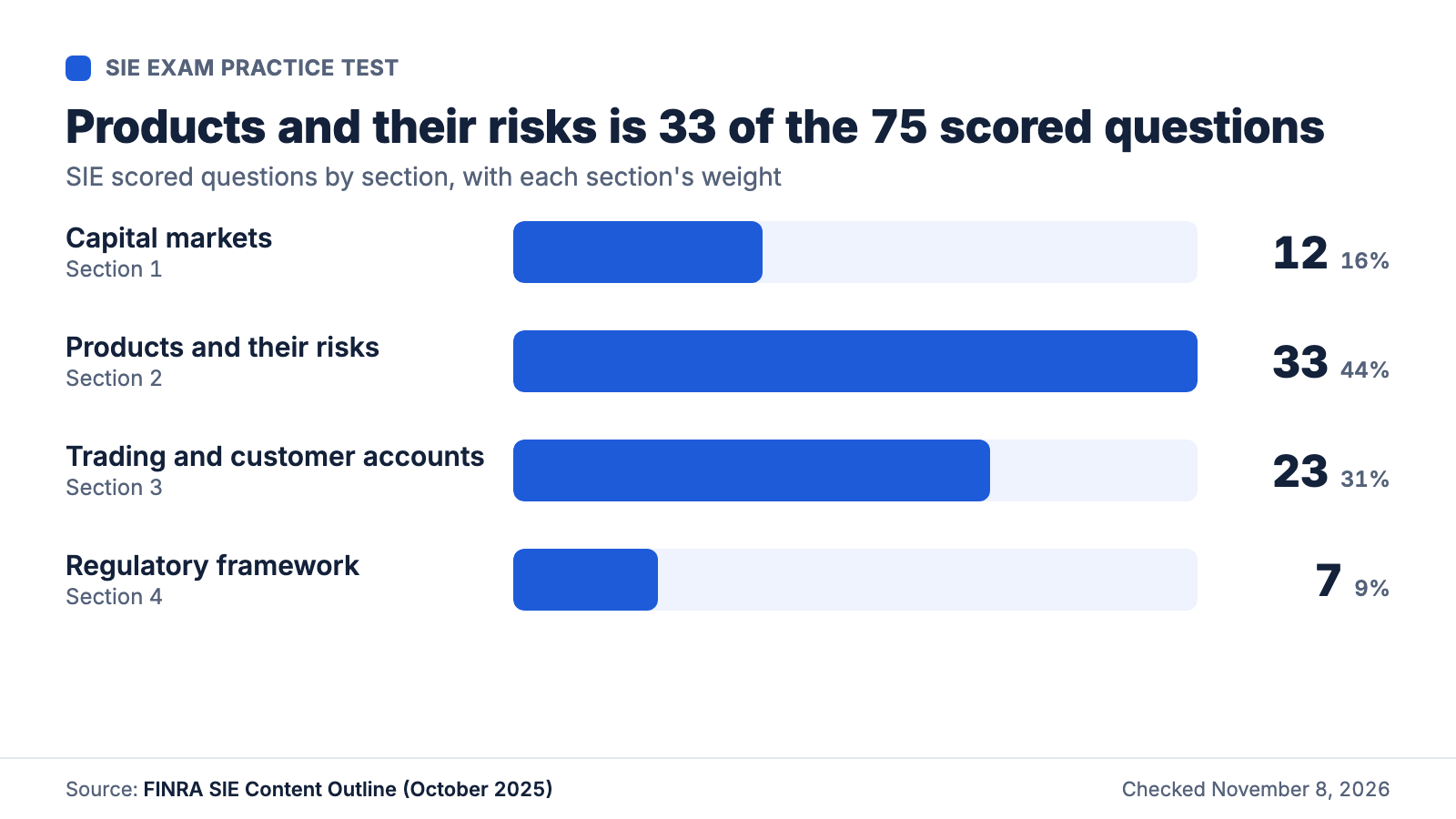
An SIE study plan divides your available days across FINRA's four exam sections by their weight, opens with a timed diagnostic test and brings every missed topic back at fixed review intervals. Understanding Products and Their Risks carries 44% of the 75 scored questions, so it gets the most days in every schedule below.
The one-week, two-week, one-month and six-week schedules on this page are this site's suggested plans. FINRA does not publish a recommended study time, so adjust each plan to your own results. Begin with a timed SIE practice test to see which sections cost you points.
Sources: FINRA SIE Content Outline (2025-10 version), FINRA SIE exam page, FINRA SIE FAQ and FINRA Regulatory Notice 26-18. Checked November 4, 2026.

How do you plan SIE revision by available time?
Plan SIE revision in five steps: fix the exam date, count your study days, split them by section weight, start with a timed diagnostic, then book review and checkpoint days.
- Fix the exam date. After you enroll, FINRA posts a 120-day window in which you must take the exam. The window opens the day after enrollment. Count your study days back from the appointment.
- Count usable study days. Count only the days you can actually study. A day with a short gap counts as a review day.
- Split learning days by section weight. Use FINRA's weights in the table below.
- Start with a timed diagnostic. Take a full timed practice test on day 1 and log every missed question by section.
- Book review and checkpoint days. Return to each topic at the review intervals below, and take a timed practice test at set points.
| Section (FINRA content outline) | Share of scored questions | Scored questions | Learning days out of 20 |
|---|---|---|---|
| 1. Knowledge of Capital Markets | 16% | 12 | 3 |
| 2. Understanding Products and Their Risks | 44% | 33 | 9 |
| 3. Understanding Trading, Customer Accounts and Prohibited Activities | 31% | 23 | 6 |
| 4. Overview of the Regulatory Framework | 9% | 7 | 2 |
| Total | 100% | 75 | 20 |
The first three columns are FINRA's. The last column is this site's rounding of the weights to a 20-day learning block. Scale it to your own number of days.
From the outline: "The exam consists of 75 multiple-choice items, and each item consists of four answer choices." FINRA SIE Content Outline, 2025-10 version.
What do you need before you start?
You need four things in place before day 1:
- Eligibility. You must be 18 or older. You do not need to be associated with a firm to take the SIE.
- Enrollment details. FINRA asks for your Social Security number or, if you do not have one, your mother's maiden name. These details must later match the Form U4 a firm files for you.
- The exam format. Each exam has 80 items: 75 scored and 5 unidentified pretest items. You have 1 hour and 45 minutes.
- Basic terms. If finance words are new to you, start with the terminology section below.
When should you review a topic again?
This plan reviews each topic 1 day, 3 days and 7 days after you first study it, then once more in the final week. These intervals are this site's suggested rhythm. The one-week plan compresses them to 1 and 3 days.
- Keep a missed-question log with the topic, its outline code and the reason you missed it: an unknown term, a misread question, or two rules mixed up.
- Open each study day with the reviews due that day. Re-answer the logged items, then take a short topic set.
- Remove an item from the log after you answer it correctly on two separate review days.
- Use SIE flashcards for terms between sessions.
When one topic keeps returning to the log, review the SIE study guide section for that topic before you drill it again.
How should you read practice results?
Use practice results to rank your weak topics. FINRA's passing score is 70 on a scale of 0 to 100, and FINRA adjusts scores across exam versions through a process called equating. A percentage on a practice test is a different measure, so track the sections that lose you points.
From FINRA: "The passing score for the SIE is 70 (on a scale of 0 to 100)." FINRA SIE FAQ.
Four sample questions, one from each section, show the question style before your diagnostic:
Sample question 1 · Capital markets
Which organization has the federal mission of protecting investors, maintaining fair securities markets, and facilitating capital formation?
- The Federal Deposit Insurance Corporation
- The Securities and Exchange Commission
- The Federal Reserve
- The Internal Revenue Service
Show the answer
Correct: B. The Securities and Exchange Commission
The SEC has this three-part mission. The Federal Reserve focuses on monetary policy and the banking system rather than serving as the federal securities market regulator.
Sample question 2 · Products and their risks
A customer buys an ADR listed in the United States. What does the receipt represent?
- An interest in shares of a foreign company
- A right to buy any domestic stock at par
- A direct loan to the United States Treasury
- An insured deposit in a foreign central bank
Show the answer
Correct: A. An interest in shares of a foreign company
An ADR represents foreign company shares or a fraction or multiple of them. Trading in the United States does not turn it into a Treasury obligation.
Sample question 3 · Trading and customer accounts
A customer submits a 500-share IOC buy limit at $20. Only 200 shares can immediately be purchased at $20; additional offers are $20.10. Which outcome respects both instructions?
- Cancel the entire order because IOC never permits a partial fill.
- Buy 200 shares now and keep the balance open until the limit becomes available.
- Buy the 200 available shares at $20 and cancel the unfilled balance.
- Buy all 500 shares by paying $20.10 for the balance.
Show the answer
Correct: C. Buy the 200 available shares at $20 and cancel the unfilled balance.
IOC permits an immediate partial fill but cancels the remainder, while the buy limit prohibits paying above $20. The higher offer cannot be used simply to complete the requested quantity.
Sample question 4 · Regulatory framework
A representative buys a passive interest in a business and takes no operating role. How does Rule 3270 treat passive investments?
- It exempts passive investments from that outside business notice requirement
- It requires the business to become a FINRA member
- It categorically prohibits all passive investments
- It treats every passive holding as employment
Show the answer
Correct: A. It exempts passive investments from that outside business notice requirement
Rule 3270 expressly exempts passive investments from its requirement. That exemption should not be stretched to cover an active, compensated business role.
How long should you study for the SIE?
Your study time depends on your starting knowledge, the days you have free and the errors your first timed practice test shows. FINRA's FAQ answers its study-materials question with the content outline and gives no study-hour figure.
| Your position | Suggested plan on this page |
|---|---|
| Exam within 7 days | One-week constrained schedule |
| Exam in about 2 weeks, some finance background | Two-week schedule |
| Exam in about a month | One-month schedule |
| New to finance, or studying around a job | Six-week schedule, or the one-month plan spread over more weeks |
| Retaking after a fail | Start from your FINRA fail report |
Example you can edit: you have 30 calendar days and can study 5 days a week. That gives about 21 study days. Keep 1 for the diagnostic, 3 for timed checkpoints and 2 for final review. The other 15 become learning days: 2 for Capital Markets, 7 for Products, 5 for Trading and 1 for the Regulatory Framework.
If you have only 2 days, there is room for one timed practice test and a review of its misses. There is no room for a first pass through every outline topic. In that position, compare the cost of moving your appointment in the fall-behind section below.
What does a one-week SIE study plan look like?
A one-week SIE plan spends four of its seven days on new learning, ordered by section weight, with timed practice tests on days 1 and 6 and a light final day. Products gets two of the four learning days because it carries 44% of the scored questions.
| Day | Task | Reviews due |
|---|---|---|
| 1 | Timed practice test. Log every miss by section. | None |
| 2 | Products: equity, debt and options | Day 1 misses |
| 3 | Products: packaged products, municipal fund securities, DPPs, REITs, hedge funds, ETPs, investment risks | Day 2 |
| 4 | Trading: orders, settlement, corporate actions, account types, AML, prohibited activities | Day 3, day 1 misses |
| 5 | Capital Markets and the Regulatory Framework | Days 2 and 4 |
| 6 | Second timed practice test, then re-drill your two weakest topics | Days 3 and 5 |
| 7 | Missed-question log and terms only. No new topics. | Whole log |
In one week, spend less time on a subtopic only when your diagnostic shows you already answer it correctly.
What does a two-week SIE study plan look like?
A two-week SIE plan uses nine learning days split by weight, three timed practice tests and a light final day. In plans of two weeks or less, the order follows section weight, so the highest-value topics come first.
| Days | Task |
|---|---|
| 1 | Timed practice test (diagnostic). Log every miss. |
| 2 to 5 | Products: equity and debt; options; packaged products and municipal fund securities; DPPs, REITs, hedge funds, ETPs and investment risks |
| 6 to 8 | Trading: orders, returns, settlement and corporate actions; account types, registrations, AML, books and records, communications and best interest; prohibited activities |
| 9 | Capital Markets: regulators, SROs, market participants, market structure |
| 10 | Capital Markets: economic factors and offerings. Regulatory Framework: registration, continuing education, employee conduct, reportable events |
| 11 | Second timed practice test and review |
| 12 | Your two weakest topics, highest weight first |
| 13 | Third timed practice test and review |
| 14 | Missed-question log and terms only |
Open each day with the reviews due from 1 and 3 days earlier.
What does a one-month SIE study plan look like?
A one-month SIE plan gives 22 days to learning in FINRA's outline order, with timed practice tests on days 1, 15 and 25. Longer plans start with Capital Markets because it introduces the regulators, firms and markets that the later sections refer to.
| Days | Focus | Checkpoint |
|---|---|---|
| 1 | Timed practice test, log misses | Diagnostic |
| 2 to 4 | Capital Markets: regulators and SROs, market participants, market structure, economic factors, offerings | |
| 5 to 14 | Products: equity (1 day), debt (2), options (2), packaged products (1), municipal fund securities (1), DPPs and REITs (1), hedge funds and ETPs (1), investment risks (1) | |
| 15 | Second timed practice test and review | Checkpoint |
| 16 to 22 | Trading: orders and strategies, investment returns, settlement and corporate actions, account types and registrations, AML and books and records, communications and best interest, prohibited activities (1 day each) | |
| 23 to 24 | Regulatory Framework: registration and continuing education; employee conduct and reportable events | |
| 25 | Third timed practice test and review | Checkpoint |
| 26 to 28 | Your three weakest topics from tests 2 and 3, highest weight first | |
| 29 | Short mixed set from your missed-question log | |
| 30 | Light review and rest |
The learning days split 3, 10, 7 and 2 across the four sections, close to FINRA's 16%, 44%, 31% and 9%.
What does a six-week SIE study plan look like?
A six-week SIE plan uses six study days and one rest day each week, with timed practice tests at the start, at the end of weeks 3 and 5, and in week 6.
| Week | Focus | Checkpoint |
|---|---|---|
| 1 | Diagnostic test, Capital Markets (4 days), equity securities | Diagnostic on day 1 |
| 2 | Debt (2 days), options (2 days), packaged products, municipal fund securities | |
| 3 | DPPs, REITs, hedge funds and ETPs, investment risks, a Products review day | Timed test at week end |
| 4 | Orders and strategies, investment returns, settlement and corporate actions, account types and registrations, AML, books and records and privacy | |
| 5 | Communications and best interest, prohibited activities (2 days), registration and continuing education, employee conduct and reportable events | Timed test at week end |
| 6 | Your weakest topics (3 days), a timed test, log review, a light final day | Final timed test |
How do you study for the SIE while working full time?
Treat each plan day as one study session, put weekday evenings on single topics or reviews, and keep timed tests for days off. A timed test needs 1 hour and 45 minutes in one sitting.

- Count sessions. At 5 sessions a week, the 30 sessions of the one-month plan take about six weeks.
- Split the session types. Use short gaps, such as a commute or lunch break, for flashcards and terms. Use evenings for topic learning and reviews.
- Fix your test day early. FINRA encourages candidates to schedule their exam session as far in advance as possible to secure the date they want.
- Choose where you test. FINRA offers the SIE online with a remote proctor as well as at Prometric test centers.
From FINRA: "FINRA offers online delivery of the Securities Industry Essentials (SIE) exam." FINRA online testing page.
What finance terms should you learn before starting?
Learn the basic terms of each outline section before day 1 if you have no finance background.
| Section | Terms to know first |
|---|---|
| Capital Markets | SEC, self-regulatory organization (SRO), broker-dealer, investment adviser, primary and secondary market, monetary and fiscal policy |
| Products | stock, bond, coupon, maturity, call and put option, mutual fund, ETF, REIT |
| Trading and accounts | market, limit and stop orders, trade settlement, cash and margin accounts, anti-money laundering |
| Regulatory Framework | registration, continuing education, reportable events |
Add a terminology week before the six-week plan:
- Read the four section headings and subtopic lists in FINRA's content outline.
- Learn the terms for one section per day from the SIE exam vocabulary page.
- Review them with flashcards each day.
- On day 6, take the timed diagnostic and start week 1.
When should college students take the SIE?
College students can take the SIE at 18 or older without a firm, and a pass stays valid for four years. Time the exam so those four years cover the date you expect to join a broker-dealer.
From FINRA: "The SIE will be valid for four years from the date that you pass the exam." FINRA SIE FAQ.
If you join a broker-dealer within those four years and need to register as a general securities representative, FINRA's FAQ says you only need to pass the Series 7.
- Count forward. Add four years to your planned exam date and compare it with your graduation and job start dates.
- Fit the plan to your term. Use a break for the six-week plan, or run the one-month plan in a lighter term. Keep timed tests away from finals weeks.
- Ask about vouchers. FINRA lets academic institutions buy SIE vouchers to give to students, so check whether your school offers one.
What should career changers learn first?
Career changers should learn the Capital Markets section first, because it explains who the regulators, firms and market participants are. The later sections build on them.
Passing the SIE alone does not qualify you to register with a firm or do securities business.
From FINRA: "In order to become registered to engage in securities business, an individual must pass the SIE and a qualification exam appropriate for the type of business the individual will engage in." FINRA SIE exam page.
- Check the next exam. You must be associated with a member firm to take a qualification exam such as the Series 7.
- Check the order. FINRA's FAQ says the order in which you pass the SIE and a representative-level exam does not matter, as long as you pass both.
- Choose the plan length. Without finance work experience, use the terminology week and the six-week plan. With related experience, let your diagnostic decide between the one-month and two-week plans.
What if you fall behind your SIE study plan?
If you fall behind, keep the timed checkpoints and the light final day, and cut new learning from the lowest-weight topics your diagnostic shows you already know.
- One missed day: move it to your next rest day. In the one-week plan, drop that day's reviews.
- Three or more missed days: switch the remaining days to the one-week plan's order. Products and Trading together hold 56 of the 75 scored questions.
- Still behind 10 business days before your appointment: decide whether to move the date. Rescheduling costs nothing with 10 or more business days' notice.
| Notice before your SIE appointment | FINRA reschedule or cancellation fee |
|---|---|
| 10 business days or more | No fee |
| 3 to 10 business days | $50 |
| Within 2 business days, or a no-show | $100 |
A new date must still fall inside your 120-day window. If you do not test within the window, your enrollment expires and you must enroll again.
From FINRA: "If you need to reschedule or cancel your qualification exam appointment, you must do so a minimum of 10 business days in advance to avoid any fees." FINRA cancellation policy.
What should you do in the last days before the SIE?
In the last two days, stop learning new topics, review your missed-question log and terms, and set your pacing and test-day routine.
- Pacing. 1 hour and 45 minutes for 80 items is just under 79 seconds per item. The 5 pretest items are unidentified, so give every item the same effort.
- Answer every item. FINRA's outline states there is no penalty for guessing.
- Breaks. At a test center, breaks are for restroom use only and the timer does not pause. Online, the clock keeps running during unscheduled breaks.
- Arrival. At a test center, plan to arrive 30 minutes early. If you arrive more than 30 minutes late and no seat is free, you cannot test and must pay for a new enrollment.
- ID. Bring one valid, unexpired government-issued ID with your photo and signature. The name must match the name on your appointment.
- Sleep and timing. Keep your normal sleep time the night before. Book the appointment for the time of day you took your timed practice tests.
From the outline: "There is no penalty for guessing. Therefore, candidates should attempt to answer all items." FINRA SIE Content Outline.
Take a timed SIE practice exam
How do you review mistakes after failing the SIE?
Start your retake plan from FINRA's fail report, which shows your overall score and your performance on each topic section. Rank the sections by how far you fell short and by their weight, then rebuild the one-month plan with your weakest high-weight section first.
From FINRA: "If you receive a fail result, additional details regarding your exam performance will be provided in the results report, including your overall exam score and your performance on each of the topic sections on the exam." FINRA test center page.
- Wait out the retake period. Through January 18, 2027, you wait 30 calendar days after a first or second fail. For retake enrollments submitted on or after January 19, 2027, the wait is 15 calendar days.
- Re-enroll. A retake is a new enrollment at the SIE fee of $100.
- Take a fresh diagnostic in week 1. Compare its section results with your fail report.
- Re-learn the weak sections. Keep the review intervals and timed checkpoints from the one-month plan.
How do you plan the next attempt after failing the SIE twice?
After two fails, plan the third attempt with the six-week schedule, because a third fail in a row within two years triggers the longest wait. That wait is 180 calendar days today and 60 days under the rule that takes effect on January 19, 2027.
| Failed attempt | Wait through January 18, 2027 | Wait from January 19, 2027 |
|---|---|---|
| First | 30 calendar days | 15 calendar days |
| Second | 30 calendar days | 15 calendar days |
| Third and later, in succession within two years | 180 calendar days | 60 calendar days |
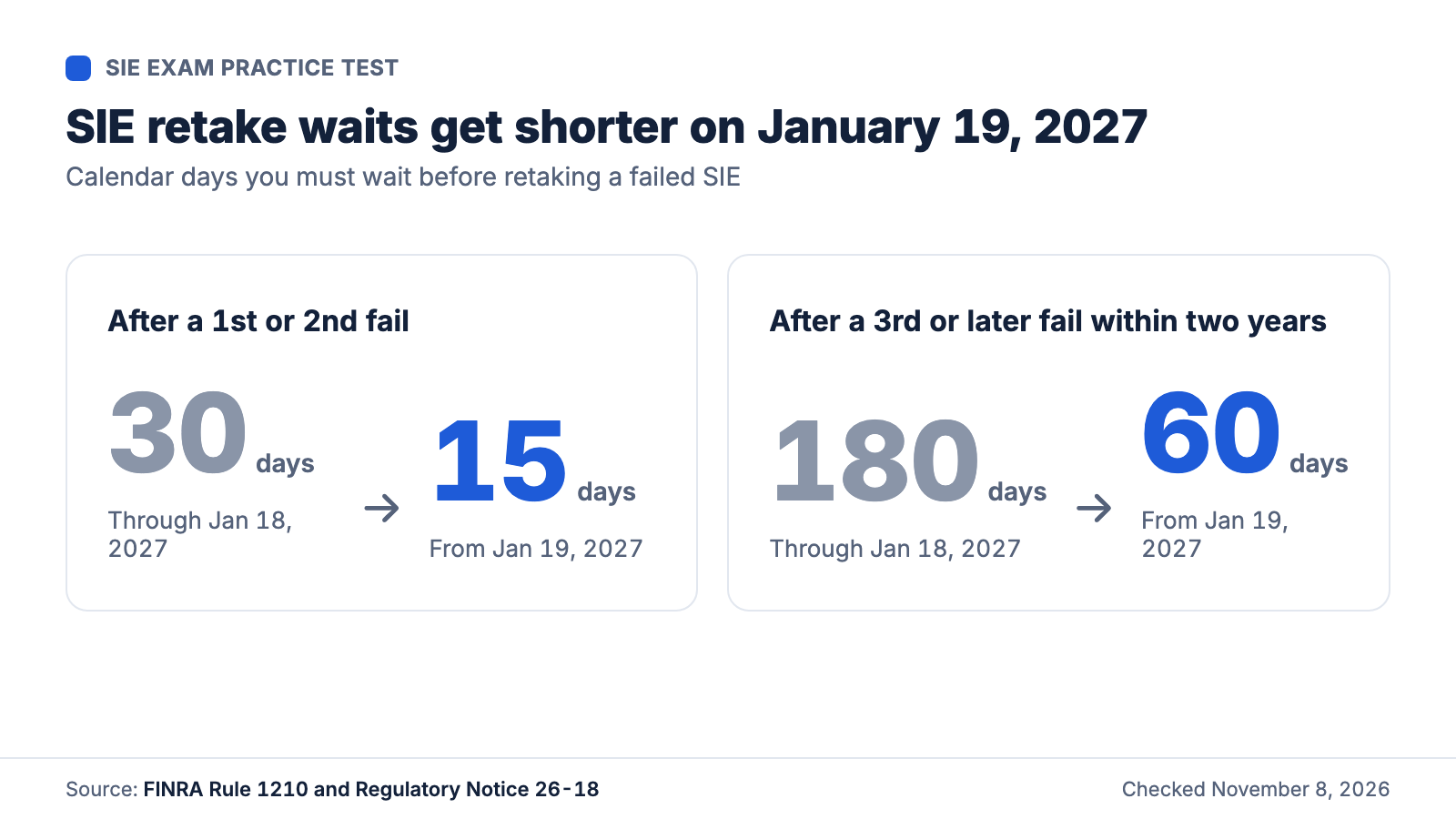
From FINRA: "from 30 calendar days to 15 calendar days after the first and second failed attempts, and from 180 calendar days to 60 calendar days after the third and any subsequent failed attempts within a two-year period." FINRA Regulatory Notice 26-18.
If you failed before January 19, 2027 and are still waiting on that date, your new testing window depends on when you enroll:
- Enrollment submitted on or after January 19, 2027: the window reflects the shorter wait.
- Enrollment submitted earlier, with no appointment booked: FINRA adjusts the window on January 19, 2027.
- Enrollment submitted earlier, with an appointment booked: FINRA cannot adjust the window without canceling the appointment and will contact you about your options.
Before you book the third attempt, check that your missed-question log has shrunk in Products and Trading across at least two timed checkpoints.
What resources are there for veterans taking the SIE?
Veterans who qualify for the GI Bill may be able to get the $100 SIE fee reimbursed. The U.S. Department of Veterans Affairs lists the licensing and certification tests it covers on its test fees page. Check your eligibility there before you enroll.
From FINRA: "Veterans who qualify for the GI Bill may be able to receive reimbursement for the cost of taking the SIE." FINRA SIE exam page.
- Enrollment. You can enroll yourself for the SIE without a firm.
- ID. FINRA's test center page lists a military ID as an accepted form of government-issued ID.
- Active duty after registration. If you were registered with a firm and go on active duty within two years after leaving, FINRA Rule 1210.10 defers the lapse of your SIE's four-year validity while you serve, provided FINRA is notified on time. See FINRA Rule 1210.
The six-week plan leaves the most room for interruptions.
Next step
To study away from a screen, print the SIE practice exam with an answer key. Every plan on this page uses no more than 3 timed practice tests in any 7 days, which a free account with a confirmed email address covers. If your plan needs more, compare SIE practice plans.