
SIE Options Practice Questions
Options are topic 2.1.3 of FINRA's SIE content outline, inside Section 2, which carries 33 of the 75 scored questions (44%). Below are 10 original options practice questions with answers and explanations, then worked examples for calls, puts, breakeven, covered calls and protective puts. For mixed questions across all four sections, take the SIE practice test.
Sources: FINRA SIE Content Outline (October 2025 version), FINRA's options page for investors, and Options Industry Council (OIC) strategy pages linked in each section. Checked October 24, 2026.
Every example on this page uses hypothetical prices. Prices are per share, one standard contract covers 100 shares, and commissions, fees, dividends and taxes are left out unless a line says otherwise.
SIE options practice questions with answers
These 10 questions cover exercise style, settlement, maximum gain and loss, breakeven, covered calls and protective puts. Answer each one before you open the explanation. Our question bank tags 193 original questions to outline 2.1.3; this page prints 10 of them.
Sample question 1 · Products and their risks
An investor owns an American-style equity option. When may the holder generally exercise it?
- Only at expiration because all options are European-style
- Only on the date the issuer declares a dividend
- At any time up to expiration, subject to exercise procedures
- On the purchase date and at no later time
Show the answer
Correct: C. At any time up to expiration, subject to exercise procedures
American-style options permit exercise before expiration as well as at expiration. European-style exercise restrictions should not be applied to every equity option.
Sample question 2 · Products and their risks
An investor exercises a cash-settled broad-based index option. What is generally delivered?
- A newly issued corporate bond
- A physical certificate for the index itself
- The contractually determined cash amount
- One share of every company in the index
Show the answer
Correct: C. The contractually determined cash amount
Cash-settled index options settle with cash rather than a basket of underlying shares. An index itself is not a stock certificate that can be delivered.
Sample question 3 · Products and their risks
A customer buys a call and asks about the theoretical maximum gain. Which response is accurate?
- It is theoretically unlimited.
- It is always limited to the premium paid.
- It cannot exceed the strike price.
- It is guaranteed to equal the stock dividend.
Show the answer
Correct: A. It is theoretically unlimited.
A long call can benefit from a stock price rising without a theoretical ceiling. The premium paid limits the holder's maximum loss, not the possible gain.
Sample question 4 · Products and their risks
A customer wrote an XYZ $30 put. At expiration XYZ trades at $34, and the put was never exercised early. Ignoring fees, what is the result for the customer?
- She must buy 100 shares at $30 at expiration.
- The put expires worthless, and she keeps the premium.
- She receives $4 per share by which XYZ beat the strike.
- She must return the premium because no exercise occurred.
Show the answer
Correct: B. The put expires worthless, and she keeps the premium.
A put with a stock price above the strike at expiration expires worthless, so the writer keeps the premium and has no further obligation. The strongest misconception is that a put writer must buy at expiration regardless of price, but the obligation arises only if the holder exercises.
Sample question 5 · Products and their risks
Two investors buy the same XYZ put. One owns 100 XYZ shares; the other owns no XYZ stock. How are their purposes best described?
- Both are hedging, because a purchased put always reduces risk
- Both are speculating, because every option purchase is leveraged
- The shareholder is hedging; the other is speculating on a decline
- The shareholder is speculating; the other is hedging against a decline
Show the answer
Correct: C. The shareholder is hedging; the other is speculating on a decline
OIC describes a long put added to long stock as insurance for the stock's value, while a stand-alone long put is bought to profit if the stock falls. The strongest misconception is that buying a put always reduces risk; without shares to protect, the put is a bearish position whose whole premium can be lost.
Sample question 6 · Products and their risks
A customer buys four standard XYZ $30 calls for $1.50 per share. Ignoring fees, at what XYZ price at expiration does the whole position break even?
- $30.00
- $28.50
- $31.50
- $36.00
Show the answer
Correct: C. $31.50
A long call breaks even at expiration at the strike plus the premium per share, $30 + $1.50 = $31.50, and buying four contracts does not move that price, because each contract recovers its own $150 cost once the call is worth $1.50 a share. The strongest error multiplies the per-share premium by the number of contracts to reach $36.00, mixing a contract count into a per-share price. Subtracting the premium gives the long-put breakeven, and the strike alone ignores the premium paid.
Sample question 7 · Products and their risks
A customer buys one standard unadjusted $30 put for $2 per share. What is the maximum possible profit before fees?
- $2,800
- $3,000
- $200
- Unlimited
Show the answer
Correct: A. $2,800
If the stock falls to zero, profit is ($30 - $0 - $2) x 100 = $2,800. The $3,000 gross payoff excludes the premium paid.
Sample question 8 · Products and their risks
A customer buys 100 shares at $38 and writes one standard $42 call for $2 per share. What is the maximum combined profit at expiration before fees?
- Unlimited
- $200
- $600
- $400
Show the answer
Correct: C. $600
Maximum profit is [($42 - $38) + $2] x 100 = $600. The $400 stock gain alone omits the premium received.
Sample question 9 · Products and their risks
An investor holds 100 XYZ shares bought at $40 and has sold one covered XYZ $45 call on them, collecting $1.50 per share. Before fees and dividends, what is the most this combined position can lose?
- $4,000
- $3,850
- Unlimited
- $4,150
Show the answer
Correct: B. $3,850
OIC gives a covered call's maximum loss as the stock purchase price minus the premium received, which occurs if the stock becomes worthless: ($40 - $1.50) x 100 = $3,850. The strongest misconception is that writing a call makes the loss unlimited; the shares cover the call, so the risk is the stock's substantial but limited downside, reduced by the premium.
Sample question 10 · Products and their risks
A stockholder's protective put expires, and no replacement hedge is purchased. What happens to the protection supplied by that put?
- The stock must be sold at the put strike even if the put expires unexercised
- It ends with the option term.
- It automatically renews without paying another option premium
- It continues automatically while the stock remains in the account
Show the answer
Correct: B. It ends with the option term.
The protection comes from rights that exist during the put term. Keeping the stock after the put expires does not preserve the expired sale right.
If you missed a question, the section below that covers its topic shows the rule and the arithmetic.
Take the full timed SIE practice exam
Options
FINRA's outline lists 11 options points under 2.1.3. The outline gives question counts by section only, so it does not say how many options questions you will see on your exam.
| Outline point | What you need to know |
|---|---|
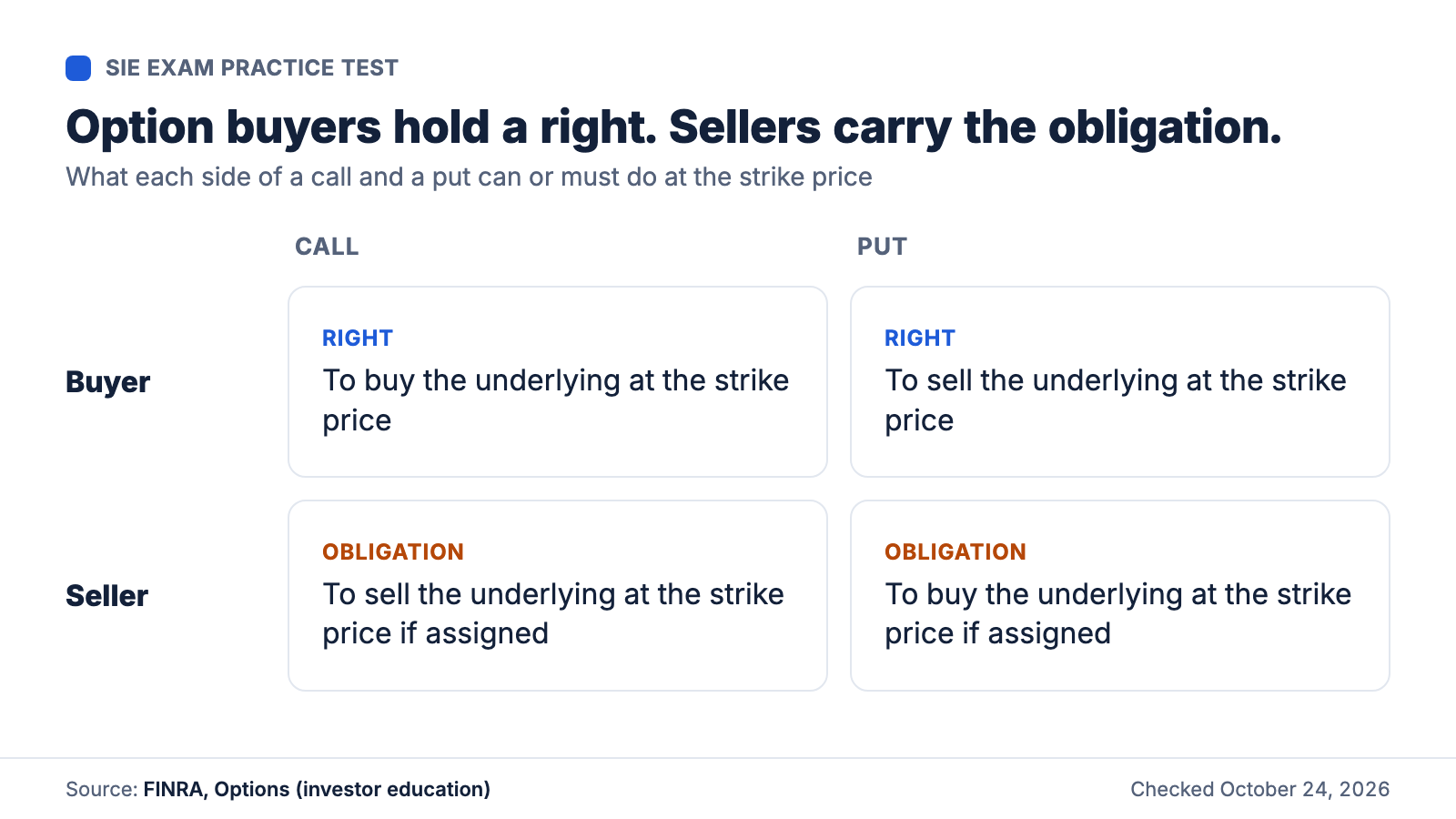
| Puts and calls | A call gives the buyer the right to buy. A put gives the buyer the right to sell. The seller of either takes on the matching obligation if assigned. |
| Equity vs. index | Equity options are on stocks and ETFs. Index options are on the value of an index, such as the S&P 500. |
| Hedging or speculation | A hedge offsets risk on a position you already hold, such as a put on stock you own. Speculation uses an option alone to profit from a price move. |
| Expiration date, strike price, premium | The strike is the price at which the contract can be exercised. The expiration date is the last day the contract is valid. The premium is the price the buyer pays and the seller receives. |
| Underlying or cash settlement | Exercising an equity option delivers shares. Exercising an index option pays cash. |
| In-the-money, out-of-the-money | A call is in the money when the stock is above the strike. A put is in the money when the stock is below the strike. At the money means the stock equals the strike. |
| Covered vs. uncovered | A covered call is written by someone who owns the stock. An uncovered (naked) call is written without owning it, and its maximum loss is theoretically unlimited. |
| American vs. European | American-style options can be exercised any time up to expiration. European-style options can be exercised only during a set period on expiration. U.S. equity options are American-style. |
| Exercise and assignment | The holder exercises. OCC assigns the exercise notice, and the seller who is assigned must buy or sell at the strike. |
| Strategies (long, short) | Long means you bought the option. Short means you sold (wrote) it. |
| Options Disclosure Document (ODD) and OCC | Firms must deliver the ODD before approving an account for options. OCC clears listed options. |
FINRA: "A standard-size options contract is equal to 100 shares of the underlying security." FINRA, Options
An option's premium has two parts. Intrinsic value is the amount the option is in the money, and time value is the rest of the premium, according to OIC's What Is an Option? page.
Call versus put rights and obligations
The buyer (holder) of an option has a right, and the seller (writer) has an obligation. A call holder may buy the stock at the strike. A put holder may sell it at the strike. The holder chooses whether to exercise. The writer must perform only if assigned.
| Position | Right or obligation | If exercised or assigned | Premium |
|---|---|---|---|
| Long call (buyer) | Right to buy 100 shares at the strike | Pays strike × 100, receives shares | Pays |
| Short call (writer) | Obligation to sell 100 shares at the strike | Delivers shares, receives strike × 100 | Receives |
| Long put (buyer) | Right to sell 100 shares at the strike | Delivers shares, receives strike × 100 | Pays |
| Short put (writer) | Obligation to buy 100 shares at the strike | Pays strike × 100, receives shares | Receives |
FINRA: "Calls convey to the purchaser the right, but not the obligation, to buy shares. They convey to the seller the obligation to sell shares if the contract is assigned." FINRA, Options
Worked example: one call, both sides
Inputs: XYZ closes at $52 on expiration day. One investor bought an XYZ 50 call for $3. Another investor wrote that call and received the $3.
- The call is in the money by $52 - $50 = $2 per share, or $2 × 100 = $200 per contract.
- Buyer: exercises, pays $5,000 for shares worth $5,200, a $200 gain on exercise. Subtract the $300 premium paid: $200 - $300 = $100 loss.
- Writer: is assigned and must sell 100 shares at $50. Buying them at $52 to deliver costs $200 more than the $5,000 received. Add the $300 premium kept: $300 - $200 = $100 gain.
Check 1: the call's breakeven is $50 + $3 = $53. XYZ closed $1 below it, and $1 × 100 = $100, the buyer's loss. Check 2: the two sides add to zero: -$100 + $100 = $0. Before fees, an option contract moves money between buyer and writer.
Wrong method: calling the $200 in-the-money amount a $200 profit leaves out the $300 premium. Forgetting the 100-share multiplier gives a $1 answer for what is a $100 result.
The same close at $52 makes an XYZ 50 put out of the money, because a put needs the stock below the strike. That put has no intrinsic value at expiration. Its buyer loses the whole premium, and its writer keeps it.
Exercise, assignment and expiration
Exercise is the holder using the contract right; assignment is the writer being selected to perform. For American-style options, a writer can be assigned on any day the equity markets are open while the short position stays open.
- Who assigns: OCC randomly assigns exercise notices to firms with customers short that option. The firm then assigns a customer at random or by another procedure of its own.
- Closing instead of exercising: a holder can sell the option to close. A writer can buy to close and end the obligation, provided the writer has not already been assigned.
- Expiration: monthly options expire on the third Friday of the month. In-the-money equity options are generally exercised automatically at expiration.
- Exercise by exception: OCC's threshold is $0.01 in the money. Options at or past it are exercised unless the firm gives contrary instructions, so a customer who does not want exercise must tell the firm before its cutoff.
- Cash needed: exercising a call means paying for 100 shares. FINRA's example: a call with a $100 strike needs $10,000 to exercise.
FINRA: "as long as a short options position remains open, the seller may be subject to 'assignment' on any day equity markets are open." FINRA, Trading Options: Understanding Assignment, December 14, 2020
OIC: "Equity options: $.01 per contract in-the-money in the customer account" OIC, Options Exercise FAQ
When an equity option is exercised, the stock trade settles as if the shares had been bought or sold on an exchange, according to OIC. Index options settle in cash, and index options generally use European-style exercise. The settlement value is fixed at expiration.
Call and put expiration breakeven
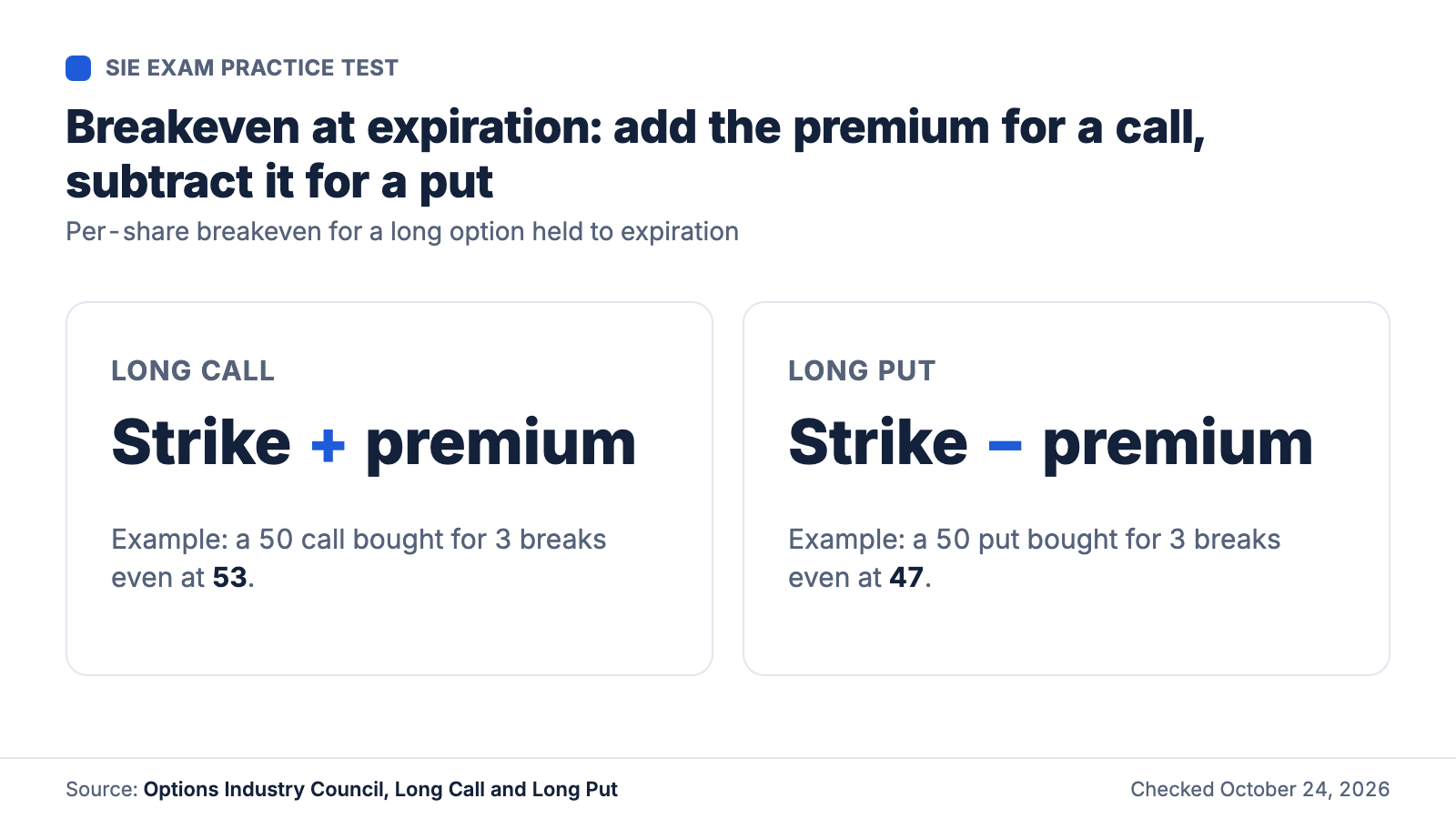
At expiration, a call breaks even at the strike plus the premium, and a put breaks even at the strike minus the premium. The buyer and the writer of the same contract share one breakeven price. The buyer profits beyond it and the writer profits short of it.
| Option | Breakeven formula | Buyer profits when the stock is |
|---|---|---|
| Call | Strike + premium | Above breakeven |
| Put | Strike - premium | Below breakeven |
OIC: "Breakeven = strike + premium" for a long call. For a long put, OIC gives breakeven as the strike minus the premium. OIC, Long Call; OIC, Long Put
Worked example: call breakeven
Inputs: buy one XYZ 60 call for $2.50 per share ($250 per contract).
- Breakeven = $60 + $2.50 = $62.50 per share.
Check 1: at $62.50 the call is in the money by $62.50 - $60 = $2.50, which equals the premium paid. Check 2: in contract dollars, ($62.50 - $60) × 100 = $250 of value against $250 paid, a net of $0.
Worked example: put breakeven
Inputs: buy one XYZ 40 put for $1.75 per share ($175 per contract).
- Breakeven = $40 - $1.75 = $38.25 per share.
Check 1: at $38.25 the put is in the money by $40 - $38.25 = $1.75, which equals the premium paid. Check 2: in contract dollars, ($40 - $38.25) × 100 = $175 of value against $175 paid, a net of $0.
Wrong method: adding the premium to the put strike gives $41.75. At $41.75 the put is out of the money and the buyer loses the full $175. A second error is multiplying the premium by the number of contracts. Buying three XYZ 60 calls at $2.50 still breaks even at $62.50, because breakeven is a price per share.
Maximum gain and loss for long and short options
A buyer's maximum loss is the premium paid, and a seller's maximum gain is the premium received. The other side of each limit depends on the option type, using the same 60 call at $2.50 and 40 put at $1.75 from the breakeven examples.
| Position | Maximum gain | Maximum loss | Breakeven |
|---|---|---|---|
| Long 60 call at $2.50 | Unlimited | $250 (premium) | $62.50 |
| Short 60 call at $2.50, uncovered | $250 (premium) | Unlimited | $62.50 |
| Long 40 put at $1.75 | ($40 - $1.75) × 100 = $3,825 | $175 (premium) | $38.25 |
| Short 40 put at $1.75 | $175 (premium) | ($40 - $1.75) × 100 = $3,825 | $38.25 |
FINRA: "For the purchaser of an option, the premium paid is your maximum loss. For the seller of an option, the premium you receive at the time of the sale is your maximum profit." FINRA, Options
The long put's maximum gain assumes XYZ falls to $0, because a stock price cannot go below zero. A call has no ceiling, so the long call's gain and the uncovered call writer's loss are theoretically unlimited.
Check 1: at $0, the put is worth $40 × 100 = $4,000. Subtract the $175 premium: $4,000 - $175 = $3,825. Check 2: the put's maximum gain also equals breakeven × 100: $38.25 × 100 = $3,825.
Wrong method: answering $4,000 uses the gross payoff and leaves out the premium paid.
Covered-call net cost, capped gain and risk
A covered call is long stock plus a short call on the same shares, and its gain is capped at the strike plus the premium. The premium lowers your net cost. In exchange, the shares can be called away at the strike if the stock rises.
| Measure | Formula (OIC) |
|---|---|
| Net cost and breakeven | Stock purchase price - premium received |
| Maximum gain | Strike - stock purchase price + premium received |
| Maximum loss | Stock purchase price - premium received |
OIC: "MAXIMUM GAIN Strike price - stock purchase price + premium received MAXIMUM LOSS Stock purchase price - premium received (substantial)" OIC, Covered Call (Buy-Write)
Worked example: covered call
Inputs: buy 100 XYZ at $50 and write one XYZ 55 call for $2. Assume both trades happen at the same time.
- Net cost = $50 - $2 = $48 per share, or $4,800. Breakeven is $48.
- Maximum gain = $55 - $50 + $2 = $7 per share, or $700.
- Maximum loss = $50 - $2 = $48 per share, or $4,800, if XYZ falls to $0.
Check 1: XYZ at $70 at expiration. The call is assigned and you sell at $55: ($55 - $50) × 100 = $500 on the stock, plus $200 premium = $700. The same $700 results at $55 or any price above it, which is the cap. Check 2: XYZ at $0. The stock loses $5,000, the premium kept is $200, and -$5,000 + $200 = -$4,800, equal to the net cost.
Wrong method: calling the maximum loss unlimited treats the call as uncovered. The 100 shares you own cover the delivery, so the loss is limited to the stock falling to zero, less the premium. Answering $500 for the maximum gain counts the stock gain and leaves out the $200 premium.
The covered call cushions a drop by only $2 per share.
Protective-put floor and maximum loss
A protective put is long stock plus a long put, and the put's strike sets a floor price for selling the stock until the put expires. Your maximum loss is the stock purchase price minus the strike plus the premium. Your gain is unlimited, less the premium paid.
| Measure | Formula (OIC) |
|---|---|
| Floor | Put strike price |
| Maximum loss | Stock purchase price - strike price + premium paid |
| Breakeven | Stock purchase price + premium paid |
| Maximum gain | Unlimited |
OIC: "The protective put establishes a 'floor' price under which investor's stock value cannot fall." OIC, Protective Put (Married Put)
Worked example: protective put
Inputs: you own 100 XYZ bought at $60 and buy one XYZ 55 put for $3. Assume the stock was bought at about the current price, which is OIC's assumption for the breakeven formula.
- Floor = $55 per share while the put is open.
- Maximum loss = $60 - $55 + $3 = $8 per share, or $800.
- Breakeven = $60 + $3 = $63 per share.
Check 1: XYZ falls to $0. You exercise and sell at $55: $5,500 - $6,000 = -$500 on the stock, minus the $300 premium = -$800. Check 2: XYZ falls to $45 instead. The result is the same -$800, because below the strike the put offsets every further dollar of decline.
Wrong method: answering $300 counts only the premium. That is the maximum loss only when the stock was bought at the strike price. Answering $6,000 ignores the put and treats the stock as unprotected.
The floor lasts only as long as the put. Once it expires, the stock has no protection unless you buy another put.
Options Disclosure Document and the OCC
Before your account is approved for options, your firm must deliver the Options Disclosure Document (ODD), titled Characteristics and Risks of Standardized Options. FINRA Rule 2360 requires delivery at or before the time the account is approved for options trading. Firms also ask you to complete an options agreement, and they approve accounts for specific levels of options trading.
FINRA Rule 2360(b)(11): "Every member shall deliver the current disclosure document of the applicable Registered Clearing Agency to each customer at or prior to the time such customer's account is approved for trading options" FINRA Rule 2360
- Current version: OCC's June 2024 ODD took effect June 3, 2024. It updated settlement information to reflect T+1 settlement. Source: OCC, Options Disclosure Document.
- Who distributes it: broker-dealers, under SEC Rule 9b-1 and their options examining authority's rules.
- What OCC does: The Options Clearing Corporation provides central counterparty clearing and settlement for listed options. It operates under the SEC, the CFTC and the Federal Reserve Board. Source: OCC, About OCC.
- Assignment: OCC assigns exercise notices at random to firms with short positions in the option series, as covered above.
How do you check a similar options question?
Work every options question in the same four steps. These steps catch the errors shown in the worked examples.
- Name the position. Long or short, call or put, and whether stock is owned (covered call, protective put) or not.
- Mark the moneyness. Call: stock above strike is in the money. Put: stock below strike is in the money.
- Write the formula before the numbers. Call breakeven = strike + premium. Put breakeven = strike - premium. Buyer's maximum loss = premium. Writer's maximum gain = premium.
- Check per share, then per contract. Get the per-share answer first, then multiply by 100 shares and by the number of contracts.
Self-check rule: test your answer at the breakeven price. At breakeven, the option's intrinsic value must equal the premium. If it does not, recheck step 3. If a term in the question is unfamiliar, look it up in our SIE term definitions.
What to study after options
Options link to two nearby topics: the products and risks in the rest of Section 2, and the account and trading rules in Section 3. For the concepts behind each outline point in order, use the SIE Exam Study Guide. For the 75-question format, practice under a timer.