
SIE Practice Exam PDF
Download a printable SIE practice test with 10 original multiple-choice questions, a separate answer key and an explanation for every answer. Print it, answer on paper, then check your work against the key. For all 75 questions on a timer, take the full SIE practice exam online. To keep practicing between sessions, use the SIE practice test on the homepage.
Sources: FINRA SIE Content Outline (2025), FINRA SIE and Exam Restructuring FAQ, and FINRA's test center page. Checked October 24, 2026.
SIE practice exam PDF
10 original questions with a separate answer key and explanations
The PDF is free to download. You don't need an account.
Printable practice test with answer key
The SIE practice exam PDF is a 10-question test you print and take on paper, with the answer key and explanations on separate pages. The key starts on a new page, so you can answer every question before you see an answer.
| Part of the PDF | What it holds |
|---|---|
| Instructions | Time limit, materials to use, how to mark your answers |
| Questions | 10 original multiple-choice questions, four answer choices each |
| Answer sheet | One line per question for your letter choice |
| Answer key | The correct letter for each question, on a new page |
| Explanations | Why the correct choice is right, usually why a tempting wrong choice fails, and the source for the rule |
Each question has four answer choices, the same format FINRA uses for the SIE.
From FINRA's outline: "The exam consists of 75 multiple-choice items, and each item consists of four answer choices." FINRA, SIE Content Outline.

How many questions are in the SIE practice exam PDF?
The printable test has 10 questions. There is no 75-question PDF. The 75-question practice exam on this site runs online, on a 1 hour 45 minute timer.
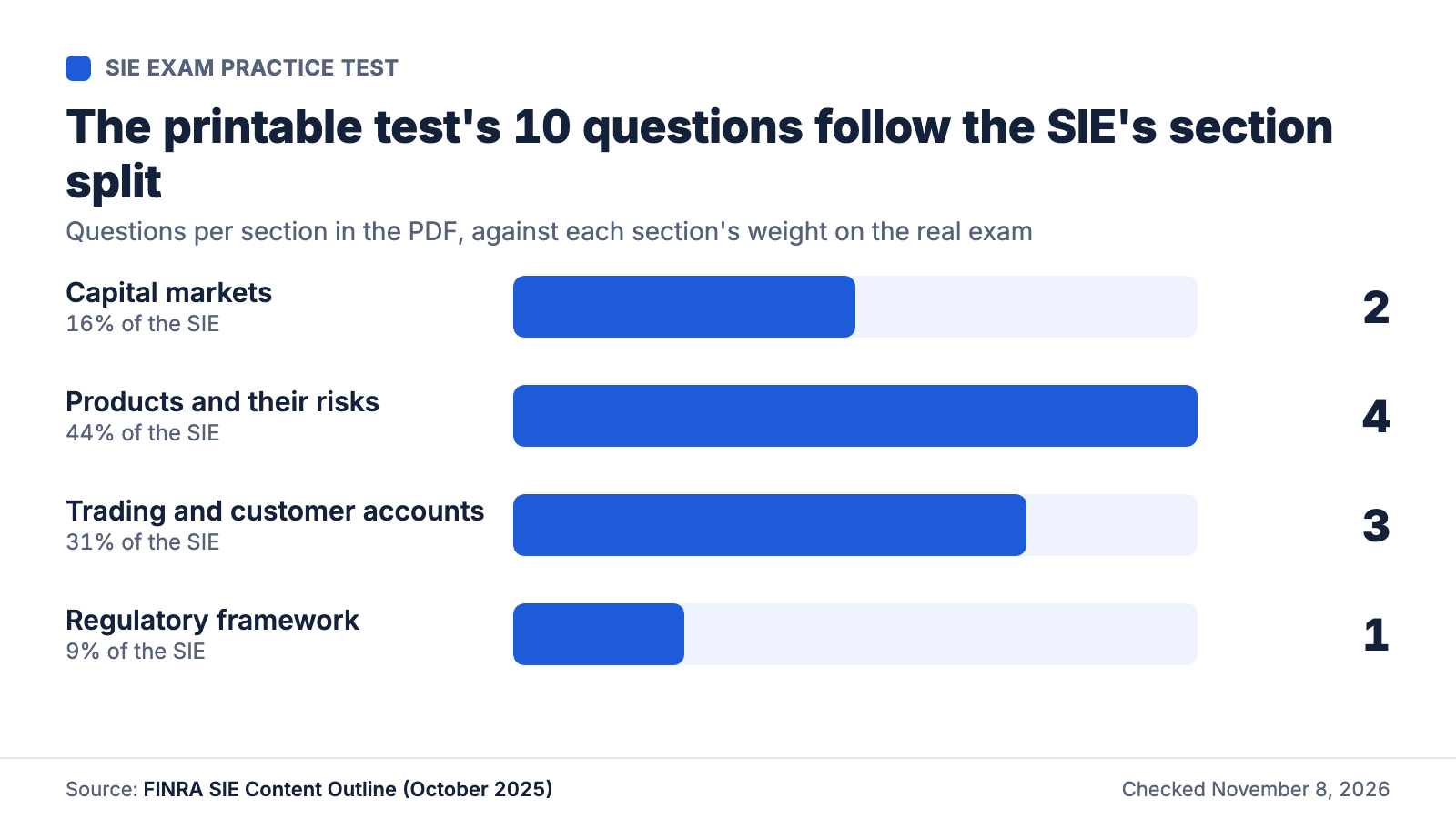
The SIE itself has 75 scored questions plus 5 unscored pretest questions, 80 in all, and FINRA allows 1 hour and 45 minutes. The 10 printable questions cover all four sections of FINRA's content outline, in about the same proportion as the exam:
| FINRA section | Share of SIE items | SIE scored items | Questions in the PDF |
|---|---|---|---|
| 1. Knowledge of Capital Markets | 16% | 12 | 2 |
| 2. Understanding Products and Their Risks | 44% | 33 | 4 |
| 3. Understanding Trading, Customer Accounts and Prohibited Activities | 31% | 23 | 3 |
| 4. Overview of the Regulatory Framework | 9% | 7 | 1 |
| Total | 100% | 75 | 10 |
Source: FINRA, SIE Content Outline, checked October 24, 2026. The PDF counts are from this site's printable test.
From FINRA's outline: "Each candidate's exam includes 5 additional, unidentified pretest items that do not contribute toward the candidate's score." FINRA, SIE Content Outline.
Take the 75-question practice exam
Which topics do the 10 questions cover?
The 10 questions cover nine subtopics from FINRA's SIE content outline, from the SEC's mission to outside business activities.
| Question | FINRA section | Outline subtopic |
|---|---|---|
| 1 | Capital Markets | 1.1.1 The SEC |
| 2 | Capital Markets | 1.2.0 Depositories and clearing corporations |
| 3 | Products and Their Risks | 2.1.1 Equity securities |
| 4 | Products and Their Risks | 2.1.3 Options |
| 5 | Products and Their Risks | 2.1.5 Municipal fund securities |
| 6 | Products and Their Risks | 2.1.8 Hedge funds |
| 7 | Trading, Accounts and Prohibited Activities | 3.1.1 Orders and strategies |
| 8 | Trading, Accounts and Prohibited Activities | 3.1.1 Orders and strategies |
| 9 | Trading, Accounts and Prohibited Activities | 3.2.1 Account types |
| 10 | Regulatory Framework | 4.2.2 Reportable events |
The same 10 questions appear below, so you can preview them or answer them on screen.
Sample question 1 · Capital markets
Which organization has the federal mission of protecting investors, maintaining fair securities markets, and facilitating capital formation?
- The Federal Deposit Insurance Corporation
- The Securities and Exchange Commission
- The Federal Reserve
- The Internal Revenue Service
Show the answer
Correct: B. The Securities and Exchange Commission
The SEC has this three-part mission. The Federal Reserve focuses on monetary policy and the banking system rather than serving as the federal securities market regulator.
Sample question 2 · Capital markets
Firm S sells 1,000 shares to Firm B on an exchange, and the trade is matched and validated at NSCC. Before settlement date, Firm B defaults. Who is now Firm S's counterparty for completing the trade?
- NSCC, which replaced Firm B as legal counterparty
- Firm B, which remains bound as original counterparty
- The exchange, which guarantees trades matched on it
- DTC, which stands behind every trade it settles
Show the answer
Correct: A. NSCC, which replaced Firm B as legal counterparty
Through novation, NSCC becomes the legal counterparty to each validated trade, so Firm S looks to NSCC for completion. Treating the original buyer as Firm S's counterparty is the strongest misconception, because central clearing exists to remove that exposure. DTC carries out the transfer and the exchange matched the orders, but neither becomes the counterparty.
Sample question 3 · Products and their risks
A customer buys an ADR listed in the United States. What does the receipt represent?
- An interest in shares of a foreign company
- A right to buy any domestic stock at par
- A direct loan to the United States Treasury
- An insured deposit in a foreign central bank
Show the answer
Correct: A. An interest in shares of a foreign company
An ADR represents foreign company shares or a fraction or multiple of them. Trading in the United States does not turn it into a Treasury obligation.
Sample question 4 · Products and their risks
A customer wrote an XYZ call that is now deep in the money. XYZ goes ex-dividend tomorrow, and the call does not expire for another month. Which risk should the customer recognize?
- Early assignment grows more likely as holders seek the dividend.
- Assignment risk falls because holders prefer to keep their time value.
- Assignment cannot occur until the call's expiration date arrives.
- The dividend lowers the strike and removes the call's intrinsic value.
Show the answer
Correct: A. Early assignment grows more likely as holders seek the dividend.
Call holders may exercise before the ex-dividend date to become stockholders and capture the dividend, so the writer's chance of early assignment rises. The belief that assignment waits for expiration ignores that equity options are American-style and can be exercised at any time.
Sample question 5 · Products and their risks
A city places tax receipts it will need for payroll over the coming months into a local government investment pool (LGIP). According to the MSRB's glossary, what does the pool's investment advisor invest in line with?
- The ages of the participants' designated beneficiaries
- The long-term retirement horizon of public employees
- The cash management needs of its participants
- The trade instructions each participant submits
Show the answer
Correct: C. The cash management needs of its participants
The MSRB's glossary says an LGIP's investment advisor invests consistent with the cash management needs of its governmental participants. Beneficiary ages are the strongest wrong answer because they drive age-based 529 options, which serve individual education accounts and not public treasuries.
Sample question 6 · Products and their risks
A hedge-fund investor has completed the initial lockup. Which contractual provision could still permit the fund to delay an otherwise eligible redemption request?
- Terms authorizing suspension of redemptions under specified conditions
- Terms specifying how NAV is calculated for an accepted redemption
- Terms setting the fee charged on a completed redemption
- Terms naming the currency in which redemption proceeds are paid
Show the answer
Correct: A. Terms authorizing suspension of redemptions under specified conditions
Hedge-fund terms can authorize redemption suspensions, including during market stress or difficulty selling investments. A NAV-calculation provision determines valuation; it does not by itself establish when a redemption request must be honored.
Sample question 7 · Trading and customer accounts
A stock gaps sharply downward through a customer's sell stop price. Which outcome is possible after the order triggers?
- Conversion into a buy limit order
- Automatic cancellation of every stop order
- A guaranteed sale at the stop price
- Execution below the stop price
Show the answer
Correct: D. Execution below the stop price
A triggered standard stop executes as a market order and may fill below the stop price in a fast market. The stop price is not a guaranteed minimum sale price.
Sample question 8 · Trading and customer accounts
A customer submits a 500-share IOC buy limit at $20. Only 200 shares can immediately be purchased at $20; additional offers are $20.10. Which outcome respects both instructions?
- Cancel the entire order because IOC never permits a partial fill.
- Buy 200 shares now and keep the balance open until the limit becomes available.
- Buy the 200 available shares at $20 and cancel the unfilled balance.
- Buy all 500 shares by paying $20.10 for the balance.
Show the answer
Correct: C. Buy the 200 available shares at $20 and cancel the unfilled balance.
IOC permits an immediate partial fill but cancels the remainder, while the buy limit prohibits paying above $20. The higher offer cannot be used simply to complete the requested quantity.
Sample question 9 · Trading and customer accounts
A customer applying for options trading asks why her firm approves accounts for a specific level instead of allowing every strategy. According to FINRA's investor guidance, what is this policy designed to do?
- Keep customers from trading beyond their abilities or means
- Keep customers from losing more than the premium they pay
- Keep firms from having to supervise options accounts
- Keep customers' positions within exchange position limits
Show the answer
Correct: A. Keep customers from trading beyond their abilities or means
FINRA says the approval policy is designed to protect investors from trading beyond their abilities or financial means, and to protect firms against potential defaults on margin accounts. Approval does not cap her losses at the premium, since FINRA warns that options trading can carry a significant risk of loss beyond the initial investment.
Sample question 10 · Regulatory framework
A representative buys a passive interest in a business and takes no operating role. How does Rule 3270 treat passive investments?
- It exempts passive investments from that outside business notice requirement
- It requires the business to become a FINRA member
- It categorically prohibits all passive investments
- It treats every passive holding as employment
Show the answer
Correct: A. It exempts passive investments from that outside business notice requirement
Rule 3270 expressly exempts passive investments from its requirement. That exemption should not be stretched to cover an active, compensated business role.
How do you take the printable test under exam conditions?
Set a 13-minute timer, put your notes away, and answer all 10 questions before you look at the answer key. 13 minutes matches the SIE's pace: FINRA allows 105 minutes for 80 items, about 1.3 minutes per item.
- Print the question pages and the answer sheet. Leave the answer key face down or unprinted.
- Put away your notes and books. FINRA exams are closed-book.
- Use a basic four-function calculator and blank paper. FINRA test centers provide a four-function calculator and erasable note boards. The online exam has an onscreen calculator and a virtual notepad.
- Answer every question. FINRA's outline says there is no penalty for guessing.
- Stop when the timer ends. Count any blank question as wrong.
From FINRA's test center page: "FINRA exams are closed-book. You are not permitted to use reference materials for the duration of your appointment." FINRA, Prepare for Your Test Center Appointment.
How do you score the printable test?
Count your correct answers out of 10 with the answer key, and write the FINRA section next to each miss. The section labels show which of the four sections cost you points.
Your printable score covers these 10 questions only. It does not convert to an SIE score. FINRA reports the SIE on a scale of 0 to 100, and the passing score is 70. FINRA also places every candidate's score on a common scale through a process called equating, so 7 out of 10 on the printable is a different measure from 70 on the SIE.
From FINRA's FAQ: "The passing score for the SIE is 70 (on a scale of 0 to 100)." FINRA, SIE and Exam Restructuring FAQ.
How do you review missed answers?
Read the explanation for every question you missed and every question you guessed. Then follow these steps for each one.
- Read why the correct choice is right.
- Read why the choice you picked is wrong. Most explanations name the most tempting wrong answer.
- Open the source link on the key to read the rule or definition in full.
- Find the outline subtopic in the table above and study it in the SIE study guide.
Sources and question provenance
Every question in the PDF was written for this site, and every explanation links the public source it relies on. The 10 explanations cite Investor.gov, FINRA.org, DTCC, the MSRB and OptionsEducation.org.
These are practice questions. FINRA did not write or review them, and this site is not affiliated with FINRA. To see how questions are written, sourced and corrected, read Our Question Methodology.