
What Is the SIE Exam?
The Securities Industry Essentials (SIE) exam is FINRA's introductory exam for people entering the securities industry. It has 75 scored multiple-choice questions plus 5 unscored pretest questions, a 1 hour 45 minute time limit, a passing score of 70 and a $100 fee. You must be 18 or older. You do not need a firm sponsor, and a pass stays valid for four years. Try the format first with a free SIE practice test.
Sources: FINRA SIE exam page, SIE FAQ, SIE Content Outline (2025-10 PDF), scheduling, test center, online testing, cancellation and accommodations pages, FINRA Regulatory Notice 26-18, the Prometric FINRA page and the NASAA exam FAQ. Checked November 4, 2026.
| SIE fact | Value |
|---|---|
| Scored questions | 75 multiple choice, four answer choices each |
| Unscored pretest questions | 5, mixed in at random (80 in total) |
| Time to answer | 1 hour 45 minutes (105 minutes) |
| Passing score | 70 on a 0 to 100 scale |
| Fee | $100 |
| Minimum age | 18 |
| Sponsor needed | No |
| Testing window | 120 days from enrollment |
| Result valid for | 4 years from the date you pass |
| Where you test | Prometric test center or online |
What the SIE exam is and how it works
The SIE tests basic securities industry knowledge: products and their risks, how the markets are structured, regulatory agencies and prohibited practices. FINRA describes it as an introductory-level exam for prospective securities industry professionals.
The SIE is one half of the requirement to become a registered representative. The other half is a qualification exam, such as the Series 7, that matches the work you will do. You can take the SIE on your own. You can take a qualification exam only after a FINRA member firm associates you.
FINRA: "Passing the SIE alone does not qualify an individual for registration with a FINRA member firm or to engage in securities business." FINRA SIE exam page, checked November 4, 2026.
Who can take the SIE exam?
Anyone aged 18 or older can take the SIE. FINRA names students, people considering a securities career and formerly registered individuals without SIE credit as candidates who can enroll themselves.
The eligibility rules are:
- Age: 18 or older.
- Citizenship: you do not have to be a US citizen.
- Firm association: none required.
- Identification at enrollment: your Social Security number, or your mother's maiden name if you do not have one.
The details you enroll with must exactly match the details a firm later files on your Form U4. If they do not match, your result will not be imported into your CRD record and you may have to retest.
FINRA: "You must be 18 years or older to take the SIE." SIE FAQ, checked November 4, 2026.
Do you need a sponsor to take the SIE?
No. You do not need any association with a broker-dealer to take the SIE. The sponsorship rule applies to the next step. You must be associated with a broker-dealer to take a FINRA qualification exam such as the Series 7.
| Exam | Firm association needed to sit it? | Source |
|---|---|---|
| SIE | No | FINRA SIE FAQ |
| Series 6, Series 7 and other FINRA representative exams | Yes | FINRA SIE FAQ and SIE page |
| Series 9/10 and other principal exams | Yes, association and sponsorship | FINRA Series 9/10 page |
| Series 63, 65, 66 (NASAA exams) | No | NASAA exam FAQ |
How much does the SIE exam cost?
The SIE exam costs $100. That fee covers one enrollment and its 120-day testing window.
Other costs can apply:
| Cost | Amount | When it applies |
|---|---|---|
| SIE enrollment | $100 | Each time you enroll, including every retake |
| Reschedule or cancel 3 to 10 business days before | $50 | Changing a booked appointment late |
| Reschedule or cancel within 2 business days, or no-show | $100 | Equal to the exam fee |
| Approved testing accommodations | $0 | FINRA provides them free; you pay for your own disability documentation |
If a firm enrolls you, the fee is charged to the firm's Flex-Funding Account. Schools, training companies and firms can also buy SIE vouchers for candidates. Veterans who qualify for the GI Bill may be able to get the SIE fee reimbursed.
FINRA: "The cost of the SIE exam is $100." SIE FAQ, checked November 4, 2026. Late fees: FINRA cancellation policy, checked November 4, 2026.
How do you register for the SIE exam?
You register for the SIE through FINRA's Test Enrollment Services System (TESS), or a firm enrolls you through CRD. Self-enrollment takes three steps:
- Create an account.
- Enroll for the SIE and pay by credit card or ACH, or redeem a voucher.
- Schedule your appointment with Prometric, at a test center or online.
A firm with CRD access can enroll you by filing Form U4 or by uploading your details directly. FINRA's SIE page recommends a Windows laptop or desktop for enrolling, because users have reported problems enrolling on Mac, mobile and tablet devices.
Your testing window opens the day after you enroll. For example, if you enroll on December 31, the window opens on January 1.
FINRA: "Enroll for the SIE, paying with credit card or ACH, or by redeeming a voucher." FINRA SIE exam page, checked November 4, 2026.
When can you take the SIE exam?
The SIE has no fixed national test dates. You book any open appointment inside your 120-day testing window. The window starts on the next calendar day after enrollment, unless a retake waiting period applies. If you do not test within the 120 days, your enrollment expires and you must enroll and pay again.
To book a test center seat, use Prometric's scheduling page or call Prometric at (800) 578-6273. The call center is open Monday to Friday 8 a.m. to 8 p.m. ET and Saturday to Sunday 10 a.m. to 4 p.m. ET, excluding federal holidays. Appointment availability varies by test center. FINRA's reschedule table sets deadlines for appointments on every day from Sunday to Saturday. FINRA advises booking as far ahead as possible to get the date you want.
FINRA: "FINRA will post a 120-day window in which the exam must be taken." FINRA scheduling page, checked November 4, 2026.
Can you take the SIE exam online?
Yes. The SIE is available online to any candidate with an open enrollment window, as well as at Prometric test centers. Most other FINRA exams need an approved accommodation before you can test online. The SIE does not.

| Requirement | Online (ProProctor) | Test center |
|---|---|---|
| Software | Install Prometric's ProProctor app and run the system check | None |
| Camera | External USB camera, or an undocked laptop with a built-in camera, moved to show a full 360-degree view | Provided |
| Connection | Stable internet; FINRA suggests a wired connection | Provided |
| Calculator and notes | Onscreen calculator and virtual notepad | Four-function calculator and erasable note boards |
| Breaks | Restroom only, after telling the proctor; the clock keeps running | Restroom only; the timer does not pause |
| Accommodations | Extra time only (approved accommodation or LEP) | Full range of approved accommodations |
If you use a company laptop, its security settings may block the ProProctor software. Check with your company's technical support first. To switch from a booked test center appointment to online, you must cancel the center appointment first, and rescheduling fees may apply.
NASAA will stop remote testing for the Series 63, 65 and 66 on January 4, 2027. That change does not apply to the SIE.
FINRA: "The Securities Industry Essentials (SIE) exam is available for online test delivery to any candidates with open enrollment windows." FINRA scheduling page, checked November 4, 2026.
What does the SIE exam cover?
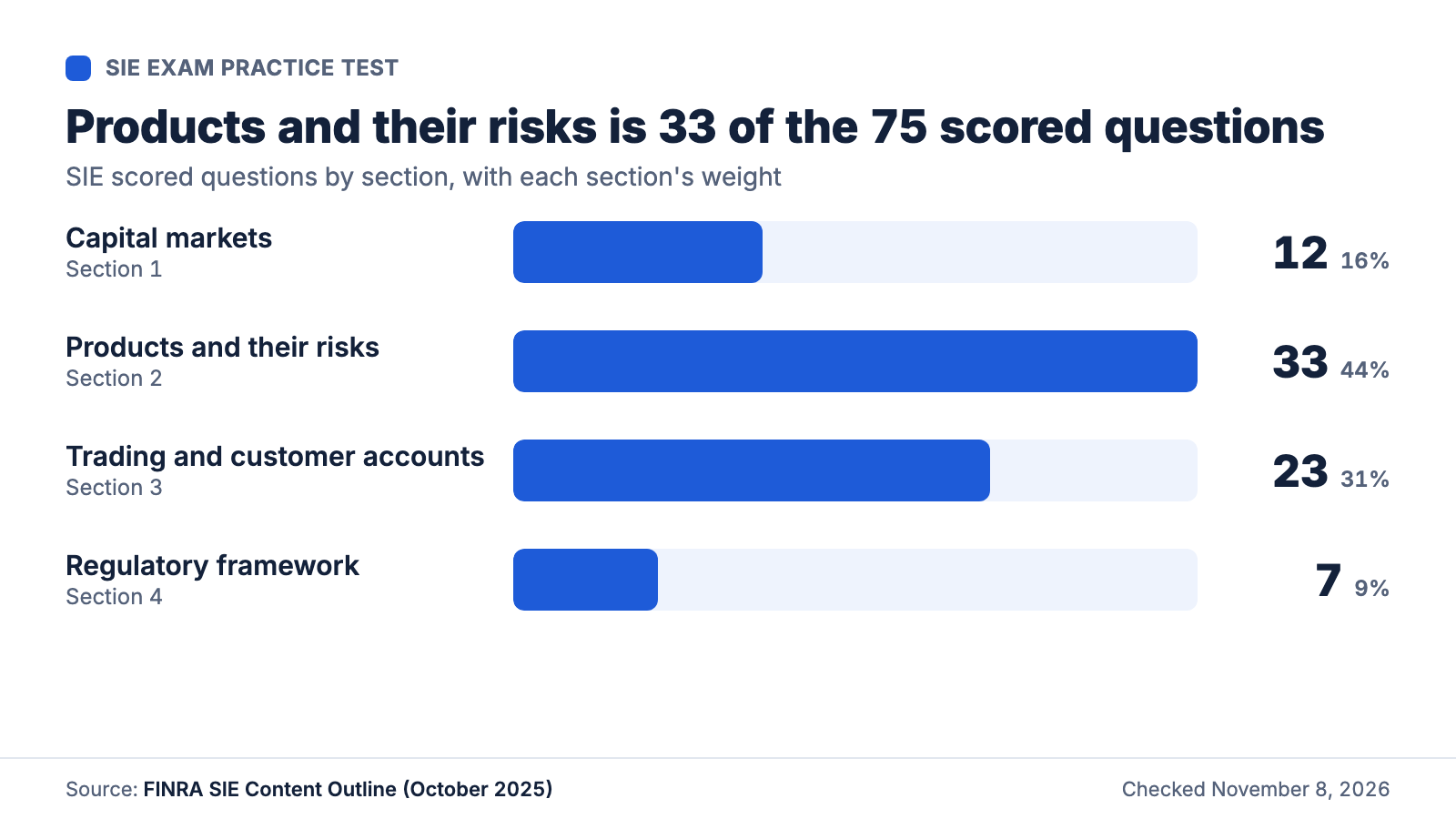
The SIE covers four sections set by FINRA's content outline: capital markets, products and their risks, trading and customer accounts, and the regulatory framework. Products is the largest section, with 33 of the 75 scored questions.
| Section | Name | Share of exam | Scored questions |
|---|---|---|---|
| 1 | Knowledge of Capital Markets | 16% | 12 |
| 2 | Understanding Products and Their Risks | 44% | 33 |
| 3 | Understanding Trading, Customer Accounts and Prohibited Activities | 31% | 23 |
| 4 | Overview of the Regulatory Framework | 9% | 7 |
| Total | 100% | 75 |
The outline tests both rule-based knowledge, such as Form U4 filing requirements, and general industry concepts, such as how a bond's price and yield relate. It draws on the Securities Act of 1933, the Securities Exchange Act of 1934, the Investment Company Act of 1940 and the Investment Advisers Act of 1940. For the topics in each section, use our SIE study guide.
FINRA outline: "The exam will assess candidates on both rule- and non-rule-based industry knowledge." SIE Content Outline (PDF), checked November 4, 2026.
What is the SIE exam format?
The SIE is a computer-based exam of 80 multiple-choice questions, each with four answer choices. 75 are scored. 5 are unscored pretest questions placed at random, and you cannot tell which ones they are. A tutorial runs before the exam starts.
There is no penalty for guessing, so answer every question. The exam is closed book.
These sample questions from our bank show the four-choice format, one from each outline section:
Sample question 1 · Capital markets
Which organization has the federal mission of protecting investors, maintaining fair securities markets, and facilitating capital formation?
- The Federal Deposit Insurance Corporation
- The Securities and Exchange Commission
- The Federal Reserve
- The Internal Revenue Service
Show the answer
Correct: B. The Securities and Exchange Commission
The SEC has this three-part mission. The Federal Reserve focuses on monetary policy and the banking system rather than serving as the federal securities market regulator.
Sample question 2 · Products and their risks
A customer buys an ADR listed in the United States. What does the receipt represent?
- An interest in shares of a foreign company
- A right to buy any domestic stock at par
- A direct loan to the United States Treasury
- An insured deposit in a foreign central bank
Show the answer
Correct: A. An interest in shares of a foreign company
An ADR represents foreign company shares or a fraction or multiple of them. Trading in the United States does not turn it into a Treasury obligation.
Sample question 3 · Trading and customer accounts
A customer submits a 500-share IOC buy limit at $20. Only 200 shares can immediately be purchased at $20; additional offers are $20.10. Which outcome respects both instructions?
- Cancel the entire order because IOC never permits a partial fill.
- Buy 200 shares now and keep the balance open until the limit becomes available.
- Buy the 200 available shares at $20 and cancel the unfilled balance.
- Buy all 500 shares by paying $20.10 for the balance.
Show the answer
Correct: C. Buy the 200 available shares at $20 and cancel the unfilled balance.
IOC permits an immediate partial fill but cancels the remainder, while the buy limit prohibits paying above $20. The higher offer cannot be used simply to complete the requested quantity.
Sample question 4 · Regulatory framework
A representative buys a passive interest in a business and takes no operating role. How does Rule 3270 treat passive investments?
- It exempts passive investments from that outside business notice requirement
- It requires the business to become a FINRA member
- It categorically prohibits all passive investments
- It treats every passive holding as employment
Show the answer
Correct: A. It exempts passive investments from that outside business notice requirement
Rule 3270 expressly exempts passive investments from its requirement. That exemption should not be stretched to cover an active, compensated business role.
FINRA outline: "There is no penalty for guessing. Therefore, candidates should attempt to answer all items." SIE Content Outline (PDF), checked November 4, 2026.
How many questions are on the SIE exam?
The SIE has 80 questions: 75 scored and 5 unscored pretest questions. Only the 75 count toward your score. Older study materials may say 10 pretest questions and 85 in total. The current outline says 5 and 80.
FINRA outline: "each candidate's exam consists of a total of 80 items (75 scored and 5 unscored)." SIE Content Outline (PDF), checked November 4, 2026.
How long is the SIE exam?
You get 1 hour and 45 minutes (105 minutes) to answer the SIE questions. Prometric books the appointment for 2 hours and 15 minutes. The extra 30 minutes covers the tutorial before the exam and the survey after it, and cannot be used to answer questions.
Pacing works out at about 1 minute 19 seconds per question (105 minutes divided by 80 questions). Unscheduled breaks come out of your exam time, at a test center and online.
Prometric: "if you are scheduled to take the SIE exam, your SIE appointment will be scheduled for 2 hours and 15 minutes." Prometric FINRA page, checked November 4, 2026.
Can you use a calculator on the SIE exam?
Yes. FINRA provides the calculator: a four-function calculator at test centers and an onscreen calculator online. At a test center you also get erasable note boards, dry-erase markers and noise-cancelling headphones, all returned at the end. Online, you get a virtual notepad for notes.
Personal items, including electronic devices, phones and watches, go in a locker at the test center. Do not bring study materials.
FINRA: "FINRA online exams have an onscreen calculator and a virtual notepad to capture your notes digitally." FINRA online testing page, checked November 4, 2026.
What do you need on SIE test day?
Bring one valid, unexpired, government-issued ID with your photo and signature, such as a driver's license, passport or military ID. The name on it must exactly match the name your exam is booked under. Electronic, photocopied or faxed IDs are refused.
Test day checklist:
- Arrive 30 minutes early. Online, check in 30 minutes before your appointment time.
- Do not be more than 30 minutes late. If no seat is free for your full time, you cannot test and must pay for a new enrollment.
- Know the email used to book. If a firm booked for you, the appointment is probably under the firm's email.
- Expect a security check. Staff or the online proctor check pockets, sleeves and pant legs and take your photo. Online, you also show your ears.
- Leave reference materials behind. FINRA exams are closed book.
FINRA: "Bring one valid, government-issued identification with a signature and picture, such as an unexpired driver's license, passport or military ID." FINRA test center page, checked November 4, 2026.
How do you request SIE testing accommodations?
Submit FINRA's Testing Accommodations Request Form and get approval before you schedule your appointment. FINRA typically responds within 10 business days. Missing or incomplete documents delay it.
- Open your SIE enrollment window.
- Complete Part One of the form yourself, or have your firm complete it.
- Have a licensed professional complete Part Two. They must have treated or consulted with you within the last five years and know your current functioning.
- Wait for FINRA's written decision.
- Schedule with Prometric. Once an appointment is booked, accommodations cannot be added or changed.
Approved accommodations are free. You pay only for obtaining your documentation. Older assessments can still establish a disability. Accommodations can include extra time, a reader or recorder, and a paper exam (test center only, with 14 days' preparation and 7 business days to score). Online appointments can offer extra time only. Temporary conditions such as sprains or broken bones do not usually qualify. If you retake the SIE or move on to another exam, FINRA reapplies approved accommodations to the new enrollment within five business days.
Limited English proficiency (LEP): an approved SIE candidate gets 30 extra minutes, the amount for exams up to 2 hours long. Submit FINRA's web-based LEP Request Form and allow about five business days. Wait for FINRA's email before you schedule.
FINRA: "Candidates must be approved with accommodations prior to scheduling an exam appointment." FINRA accommodations page, checked November 4, 2026. LEP: FINRA LEP page, checked November 4, 2026.
What can you do about SIE exam anxiety?
Learn the exam conditions in advance, and if a documented disability affects your testing, request accommodations before you book. FINRA's accommodation process covers emotional and psychological disorders. It needs documentation from a mental health professional that includes a DSM diagnosis. A self-assessment is generally not enough.
Steps that reduce surprises on the day:
- Watch FINRA's exam tutorial, linked from its SIE pages, to see how the screens work.
- Take a full timed practice exam so the 105-minute clock is familiar.
- Read the check-in rules above so ID and arrival time are settled.
- Know that unscheduled breaks use exam time.
Take a timed SIE practice exam
What does it cost to reschedule or cancel the SIE?
Rescheduling or canceling at least 10 business days ahead is free. Within 3 to 10 business days it costs $50. Within 2 business days, or if you miss the appointment, it costs $100. Deadlines fall at midnight Eastern Time on the days set in FINRA's table.
| Appointment day | Free change deadline (avoids the $50 fee) | Late deadline (avoids the $100 fee) |
|---|---|---|
| Sunday or Monday | Sunday two weeks before | Wednesday of the preceding week |
| Tuesday | Monday two weeks before | Thursday of the preceding week |
| Wednesday | Tuesday two weeks before | Sunday of the same week |
| Thursday | Wednesday two weeks before | Monday of the same week |
| Friday | Thursday two weeks before | Tuesday of the same week |
| Saturday | Friday two weeks before | Wednesday of the same week |
If you self-enrolled through TESS, a late cancellation or no-show forfeits your $100 fee and uses up the enrollment. You must pay again to open a new window. If a firm enrolled you, the firm is charged and your window stays open. FINRA has no hardship policy, and a missed enrollment window is not refunded. Reschedule or cancel through Prometric at (800) 578-6273.
FINRA: "SIE Securities Industry Essentials (SIE) $100 $50" (late fee, then 3 to 10 business day fee). FINRA cancellation policy, checked November 4, 2026.
What is the passing score for the SIE?
The SIE passing score is 70 on a scale of 0 to 100. FINRA equates scores. That means it adjusts each score for small differences in difficulty between question sets, so every candidate meets the same standard.
Because of equating, 70 does not convert to a fixed number of correct answers out of 75. A raw 70% on a practice test is a different measure from an equated score of 70.
FINRA: "The passing score for the SIE is 70 (on a scale of 0 to 100)." SIE FAQ, checked November 4, 2026.
How do you get your SIE results?
You see a pass or fail result on screen shortly after you finish. At a test center you also get a printed pass/fail report. Online, the on-screen result is unofficial, and the official report arrives by email within three business days.
| Result | What the report shows |
|---|---|
| Pass | Pass only, with no score details |
| Fail | Your overall score and your performance in each topic section |
If you think a question was flawed, you can submit FINRA's Exam Question Challenge Form within 30 days of testing. FINRA replies in writing within 20 days of receiving it.
FINRA: "If you receive a pass result, no additional scoring details will be provided." FINRA online testing page, checked November 4, 2026.
What is the SIE exam pass rate?
FINRA does not publish an SIE-only pass rate. A 2026 FINRA rule filing says over 70 percent of candidates pass the SIE, Series 7 and Series 24 on the first attempt. That figure covers the three exams together, for candidates whose first attempt was in 2024. The same filing says 65 percent of people who fail the SIE take it a second time.
FINRA: "Over 70 percent of individuals pass these qualification examinations on the first attempt." FINRA rule filing SR-FINRA-2026-014, 91 FR 43678, checked November 8, 2026.
How hard is the SIE exam?
FINRA does not publish a difficulty rating for the SIE. These official facts shape how hard it feels:
- Breadth: each exam covers some, but not all, of the outline, so you need to prepare for every topic in it.
- Weighting: products and their risks make up 44% of the scored questions.
- Mixed knowledge: questions test specific rules and general industry concepts.
- Time: 105 minutes for 80 questions.
- Guessing: there is no penalty for a wrong answer, so answer every question.
When you know your exam date, plan your SIE study around the four sections and their weights.
FINRA: "each SIE exam will include some, but not all, of the content covered on the SIE exam content outline." FINRA SIE practice test page, checked October 24, 2026.
What is a good score on SIE practice exams?
No practice score guarantees a pass, and FINRA says its own practice test should not be taken as an absolute prediction of your result. A practice test shows the share of questions you answered correctly. The real exam reports an equated score. The two numbers are on different scales.
Use practice scores to find weak sections. Compare your results by section against the outline weights, and spend more time where a heavily weighted section is low. A FINRA fail report gives section performance for the same reason.
FINRA: "Your performance on these sample questions should not be taken as an absolute prediction of your performance on the actual SIE exam." FINRA SIE practice test page, checked October 24, 2026.
Are SIE practice exams harder than the real exam?
There is no published way to compare a vendor's practice questions with the live SIE. FINRA does not endorse any vendor's materials. Its own free practice test has 75 questions "similar to those you might find on the SIE exam" and is untimed.
Our questions are original practice items written against FINRA's content outline. They are not FINRA exam questions. This site is independent of FINRA and is not the official exam administrator. Read the SIE Practice Disclaimer for how this site relates to the official exam.
What happens if you fail the SIE?
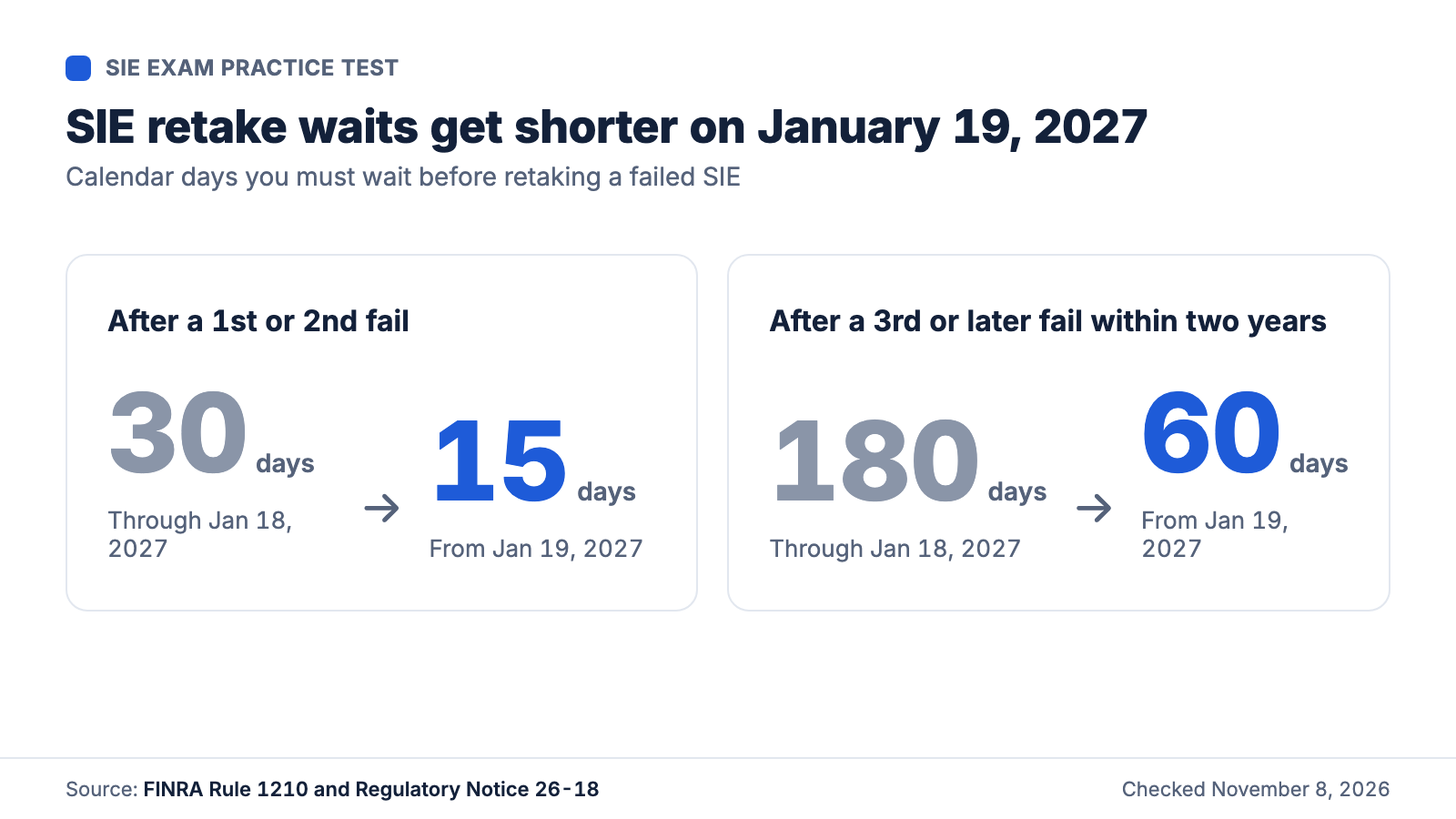
You wait out a retake period, then enroll again and pay the $100 fee again. The waiting period depends on how many times you have failed and on the date. FINRA shortens the waits on January 19, 2027.
| Failed attempt (within two years) | Wait through January 18, 2027 | Wait from January 19, 2027 |
|---|---|---|
| First | 30 calendar days | 15 calendar days |
| Second | 30 calendar days | 15 calendar days |
| Third and each one after | 180 calendar days | 60 calendar days |
If you fail before January 19, 2027, the new wait applies like this:
- Retake enrollment requested on or after January 19, 2027: the window reflects the shorter wait automatically.
- Requested before January 19, 2027, with no appointment booked: FINRA adjusts the window on January 19, 2027.
- Requested before January 19, 2027, with an appointment booked: FINRA cannot adjust the window without canceling the appointment, and it will contact you. Rescheduling fees may apply if you choose an earlier date.
FINRA will not process reduction requests made before January 19, 2027. Failed attempts more than two years old do not count. The wait applies only to the exam you failed, so failing the SIE does not delay a Series 7 attempt.
To retake, self-enrolled candidates submit a new request and pay again in TESS. If a firm enrolled you, the firm re-requests the exam through CRD and pays another fee. Either way you get a new 120-day window.
FINRA: "from 30 calendar days to 15 calendar days after the first and second failed attempts, and from 180 calendar days to 60 calendar days after the third and any subsequent failed attempts within a two-year period. The amendments will become effective on January 19, 2027." FINRA Regulatory Notice 26-18, checked November 4, 2026.
How long is the SIE valid?
A passed SIE is valid for four years from the date you pass. If a firm hires you within those four years, you only need to pass the qualification exam, such as the Series 7, to register. If you register and later leave, the SIE stays valid for four years from the date your representative-level registration ends.
Your SIE result moves into your CRD record when a firm files your Form U4, as long as your enrollment details match. FINRA Rule 1210 has separate provisions for military service.
FINRA: "The SIE will be valid for four years from the date that you pass the exam." SIE FAQ, checked November 4, 2026.
What should you do after passing the SIE?
Your next step is to become associated with a FINRA member firm and pass the qualification exam for the work you will do. The firm enrolls you for that exam by filing Form U4. Make sure the personal details on the U4 match your SIE enrollment exactly, or your SIE result will not import.
Keep track of your four-year validity date. Passing the SIE alone does not put you in BrokerCheck.
Do you take the SIE before the Series 7?
You can take them in either order, but you can only sit the Series 7 once a firm associates you. The SIE needs no sponsor, so you can take it before you join a firm. To register as a general securities representative, you must pass both. FINRA says the order does not matter.
Can you take the SIE and Series 7 together?
Yes. A person associated with a broker-dealer can take the SIE and the Series 7 on the same day. They run as separate sessions, and both need an open seat at a Prometric test center. You book each exam as its own appointment, and the appointments must not overlap.
If you pass the Series 7 but fail the SIE on that day, the Series 7 pass still counts. You then retake only the SIE.
FINRA: "The order in which you pass the exams does not matter as long as you pass both exams." SIE FAQ, checked November 4, 2026.
How does the SIE relate to the Series 6?
The Series 6 (Investment Company Representative) is a FINRA qualification exam you take with the SIE to register for that role. You need a firm to sit the Series 6. FINRA's rule that the order of passing does not matter applies to the SIE and all representative-level exams.
How does the SIE relate to the Series 7?
The Series 7 (General Securities Representative) is the qualification exam most often paired with the SIE. You need both to register as a general securities representative. The SIE needs no sponsor. The Series 7 needs firm association.
How does the SIE relate to the Series 63?
The Series 63 is a NASAA state law exam that most states require in addition to the SIE and Series 7 for broker-dealer agents. FINRA administers it for NASAA. You do not need a sponsor to take it, and NASAA lists its fee as $147. Check your state securities regulator for that state's rules.
How does the SIE relate to the Series 65?
The Series 65 is NASAA's exam for investment adviser representatives, and its role is separate from the SIE's. NASAA says passing the Series 65 is normally a prerequisite for an investment adviser representative license. NASAA lists the fee as $187, and no sponsor is needed.
FINRA's Series 65 page lists the exam's corequisites as "None." NASAA says passing either the Series 65 or the Series 66 satisfies the state-law exam prerequisite for an investment adviser representative license. NASAA names the SIE and Series 7 as co-requisites only for the Series 66 route. States set their own licensing rules, so check with your state securities regulator.
NASAA: "passing either the 65 or 66 will satisfy the exam pre-requisite under state law for being licensed as an investment adviser representative." NASAA exam FAQ, checked November 8, 2026.
How does the SIE relate to the Series 66?
A valid SIE and Series 7 are co-requisites for registering with the Series 66. NASAA treats passing the Series 66 as equal to passing both the Series 63 and Series 65. NASAA lists the fee as $177, and no sponsor is needed.
From January 4, 2027, NASAA's wait after a third failed attempt at the Series 63, 65 or 66 drops from 180 to 60 days. The wait after the first two stays at 30 days. NASAA does not shorten windows opened before that date.
NASAA: "Having a valid FINRA Securities Industry Essentials Exam and Series 7 Exam are also co-requisites for registering using the Series 66." NASAA exam FAQ, checked November 4, 2026.
What jobs can you get with only the SIE?
The SIE alone does not qualify you to register with FINRA or to engage in securities business. It has no registration category, and passing it does not put you in BrokerCheck.
FINRA describes the SIE as a way to show basic industry knowledge to prospective employers and to stand out when applying for internships or jobs. Any securities role that needs registration also needs a qualification exam taken through a firm.
How should you list the SIE on a resume?
Describe it as a passed exam with its date, for example: "Passed FINRA Securities Industry Essentials (SIE) exam, March 2026." Avoid the words "license", "licensed" or "registered". The SIE has no registration category, and passing it alone does not register you.
The pass is valid for four years, so an employer can check the date against that period.
Which securities careers connect to the SIE?
Each securities career path pairs the SIE with a FINRA qualification exam for that role. FINRA lists these on its SIE page:
| Exam | Registration |
|---|---|
| Series 6 | Investment Company Representative (IR) |
| Series 7 | General Securities Representative (GS) |
| Series 22 | DPP Representative (DR) |
| Series 57 | Securities Trader (TD) |
| Series 79 | Investment Banking Representative (IB) |
| Series 82 | Private Securities Offerings Representative (PR) |
| Series 86 and 87 | Research Analyst (RS) |
| Series 99 | Operations Professional (OS) |
Supervisory roles build on this. A General Securities Sales Supervisor needs the Series 9/10 plus the SIE and Series 7. FINRA's Manage Your Securities Industry Career page lists job categories and the exams each one needs.
FINRA: "Candidates must pass the SIE and Series 7 exams to hold the General Securities Sales Supervisor registration." FINRA Series 9/10 page, checked November 4, 2026.