
SIE Flashcards
These SIE flashcards are 30 original cards on distinctions the SIE exam outline covers, such as call vs put, CTR vs SAR and Form U4 vs Form U5. Each card names the public source its answer comes from. Flip a card, mark it Known or Review again, and filter the deck by the four SIE exam sections. When the cards feel easy, take a free SIE practice test to check the same ideas in multiple-choice form.
Sources: FINRA, SEC, Investor.gov, the Federal Reserve, FinCEN, the FFIEC and SIPC, as named on each card. Checked October 24, 2026.
See all 30 cards as a list
Capital markets
Monetary policy vs fiscal policy: who sets each?
Monetary policy is set by central banks, including the Federal Reserve, to pursue goals such as price stability, full employment and stable growth. Fiscal policy is a national government's tax and spending policy.
Capital markets
Primary market vs secondary market
In the primary market, new stocks or bonds are priced and sold, and the proceeds go to the issuer. After that, the security trades between investors in the secondary market.
Capital markets
Is FINRA part of the government?
No. FINRA is a self-regulatory organization (SRO). It is registered with the SEC and works under SEC supervision, and it is funded by member fees.
Capital markets
Broker vs dealer: which acts as agent and which as principal?
A broker effects securities transactions for the account of others and acts as agent. A dealer buys and sells securities for its own account and acts as principal.
Capital markets
What is the SIPC protection limit, and does SIPC cover market losses?
$500,000, which includes a $250,000 limit for cash. SIPC replaces missing cash and securities at a failed member firm. It does not cover a fall in the value of your investments.
Capital markets
Under Securities Act Section 8(a), when does a registration statement become effective by default?
On the 20th day after it is filed, or earlier if the SEC decides. Amendments and SEC action can change the date.
Products and risks
Call vs put: what right does the holder get?
A call holder has the right to buy the underlying at the strike price. A put holder has the right to sell it at the strike price. The holder has the right without the obligation.
Products and risks
What must the writer (seller) of a call or a put do if assigned?
A call writer must sell the underlying at the strike price. A put writer must buy the underlying at the strike price. The writer receives the premium for taking on this obligation.
Products and risks
American-style vs European-style options
American-style can be exercised at any time between purchase and expiration. U.S. equity options are American-style. European-style can be exercised only during a set period on the expiration date. Some U.S. index options are European-style.
Products and risks
Covered call vs uncovered (naked) call
Covered: you sell a call while owning the underlying stock. Uncovered: you sell a call without owning the stock. The maximum loss on an uncovered call is theoretically unlimited.
Products and risks
Interest rates rise. What happens to the price of a bond you already hold?
It falls. Bond prices and interest rates move in opposite directions. If rates rise from 6% to 7%, a 6% bond may have to sell below face value to attract a buyer.
Products and risks
General obligation (GO) bond vs revenue bond
A GO bond is backed by the issuer's power to tax residents. A revenue bond is backed by revenue from a specific project or source, such as highway tolls or lease fees.
Products and risks
Open-end fund (mutual fund) vs closed-end fund
A mutual fund continuously sells new shares and redeems shares. Most closed-end funds sell a fixed number of shares in an IPO, then the shares trade on an exchange at a market price that can be above or below NAV.
Products and risks
ETF vs ETN
An ETF holds assets. An ETN holds no assets: it is an unsecured debt security issued by a bank or other financial institution, so its value depends on the issuer's credit.
Products and risks
A company is liquidated. In what order are investors paid?
Bondholders first, then preferred stockholders. Common stockholders are last and get whatever is left, which may be nothing.
Products and risks
Maximum mutual fund sales charge under FINRA Rule 2341
8.5% of the offering price, counting front-end and deferred sales charges together, for a fund with no asset-based sales charge.
Trading and accounts
Market order vs limit order
A market order buys or sells at the current market price: execution is almost always assured, but the price may differ from what you expected. A limit order sets a price: a buy limit fills at the limit or lower, a sell limit at the limit or higher.
Trading and accounts
What happens when a stop order's stop price is reached?
The stop order becomes a market order. It can then fill at a price different from the stop price.
Trading and accounts
Record date vs ex-dividend date
The record date is when you must be on the company's books to receive the dividend. The ex-dividend date is usually the record date, or one business day before if the record date is not a business day. Buy on or after the ex-date and the seller gets the dividend.
Trading and accounts
What dollar amount triggers a Currency Transaction Report (CTR)?
A transaction in currency of more than $10,000.
Trading and accounts
What dollar amount brings a suspicious transaction at a broker-dealer into SAR reporting?
At least $5,000 in funds or other assets, when the firm knows, suspects or has reason to suspect the activity is suspicious.
Trading and accounts
Name the three stages of money laundering in order
Placement (getting illegal proceeds into the financial system), layering (moving funds through complex transactions to blur the trail), integration (making the funds look legitimate).
Trading and accounts
Regulation T initial margin for buying a stock on margin
50% of the current market value of the security.
Trading and accounts
What is the standard settlement cycle for U.S. securities trades?
T+1 (one business day after the trade date), in effect since May 28, 2024.
Trading and accounts
Rule 144 holding period for restricted securities
At least six months if the issuer has been an SEC reporting company for at least 90 days before the sale. One year if it has not.
Regulatory framework
Deadline to amend Form U4: ordinary change vs statutory disqualification
Ordinary changes: within 30 days after learning of the facts. A statutory disqualification: within 10 days after it occurs.
Regulatory framework
When must a firm file Form U5?
Within 30 days of the individual's employment end date. The firm must also give the individual a copy within 30 days.
Regulatory framework
What must a registered person do before starting an outside business activity?
Give the firm prior written notice, in the form the firm specifies. Passive investments and private securities transactions covered by Rule 3280 are exempt from this rule.
Regulatory framework
FINRA gift limit per person per year
$300, raised from $100 by Regulatory Notice 26-05, effective March 30, 2026.
Regulatory framework
Regulatory Element vs Firm Element of continuing education
The Regulatory Element is completed annually by December 31 for each registration category. The Firm Element is the continuing education program each member firm must maintain for its registered persons.
Retrieve SIE concepts from memory
To use a flashcard, answer the front from memory before you reveal the back. Answering first shows you which cards you do not know yet.
- Read the front and say or write your answer.
- Select Show answer and compare.
- Mark the card Known if your answer matched, or Review again if it did not.
- When you reach the end, turn on "Show only cards marked Review again" and go through those cards.
- Repeat until the Review again pile is empty, then shuffle the full deck.
Most cards pair two terms that are easy to swap, such as a call and a put, or a CTR and a SAR. Say both halves of the pair in your answer.
What do the flashcard controls do?
The deck has controls to flip, mark, filter and shuffle cards. Every control works with a keyboard.
| Control | What it does | Key |
|---|---|---|
| Show answer | Turns the card to the back | Space or Enter |
| Known | Marks the card as answered correctly | K |
| Review again | Marks the card to see again | R |
| Next and Previous | Moves through the deck | Right and Left arrows |
| Section filter | Shows cards from one exam section only | |
| Show only Review again | Limits the deck to cards you marked Review again | |
| Shuffle | Changes the card order | |
| Reset marks | Clears every Known and Review again mark |
The deck shows cards in the order you choose.
Which SIE sections do the cards cover?
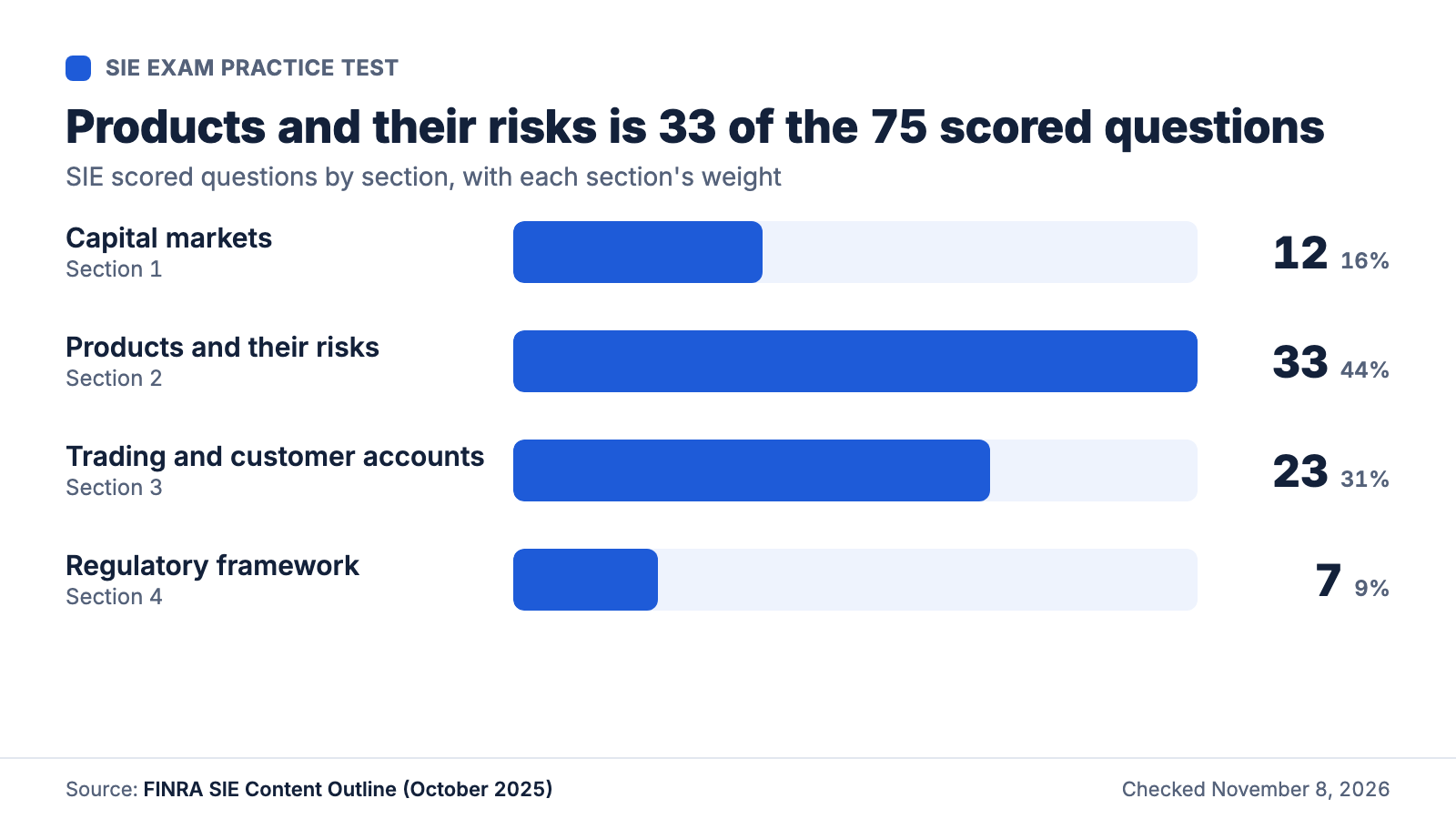
The 30 cards cover all four sections of the FINRA SIE content outline. More cards go to the heavier sections.
| SIE section | Weight | Scored questions | Cards in this deck |
|---|---|---|---|
| 1. Knowledge of Capital Markets | 16% | 12 | 6 |
| 2. Understanding Products and Their Risks | 44% | 33 | 10 |
| 3. Understanding Trading, Customer Accounts and Prohibited Activities | 31% | 23 | 9 |
| 4. Overview of the Regulatory Framework | 9% | 7 | 5 |
| Total | 100% | 75 | 30 |
From the content outline: "The exam consists of 75 multiple-choice items" FINRA, SIE Content Outline.
The section filter uses these four sections. Products and Their Risks has the most cards because it carries 44% of the exam.
Explain a difficult card
If you keep marking the same card Review again, read the full explanation of that topic before you try it again.
Look up the card's section in the SIE topic explanations. The study guide follows the FINRA outline, so the topic sits under the same section name as the card's filter. Then come back and answer the card from memory.
Clarify unfamiliar terminology
If a word on a card is new to you, look it up before you mark the card. Terms such as "writer", "assignment" or "statutory disqualification" carry exact meanings on the SIE.
Use the SIE vocabulary and glossary to check the definition. Then answer the card again with that meaning in mind.

Apply this learning through practice
After a section's cards are all marked Known, answer exam-style questions on the same topics. The SIE tests these facts in multiple-choice questions.
The SIE has 75 scored multiple-choice questions plus 5 unscored pretest questions, with 1 hour and 45 minutes to finish. Source: FINRA SIE Content Outline, checked October 24, 2026. A timed practice exam shows whether you can recall these facts at that pace.
Take a timed SIE practice exam
Can you print the SIE flashcards?
Yes. Every card is listed as plain text under the deck, so you can print the page from your browser. The printed list shows each card's front, back and source.
To quiz yourself on paper, fold the page so the answers are hidden, or cut the list into cards.
Are these cards taken from the SIE exam?
No. Each card is written by this site from the public source named on it. This site is independent of FINRA.
How current are the cards?
The sources behind every card were checked on October 24, 2026. Cards on rules that changed recently show the date of the change:
- The FINRA gift limit rose from $100 to $300 per person per year on March 30, 2026 (FINRA Regulatory Notice 26-05).
- U.S. securities moved to T+1 settlement on May 28, 2024 (SEC press release 2024-62).
See Corrections and Rule Updates for changes made after that date.