
SIE Exam Study Guide
This SIE exam study guide follows FINRA's SIE content outline in order: 4 sections, 11 topics and 35 subtopics. Each subtopic has a short explanation, a common confusion and a link to practice. The math section works through the eight calculation types with units and two checks each. Test each section as you finish it with the SIE practice test, and fit the route to your calendar with the SIE Study Plan.
Sources: FINRA SIE Content Outline (2025), FINRA SIE and Exam Restructuring FAQ, FINRA investor education pages, SEC Investor.gov glossary, FINRA and SEC rule texts linked in each section. Checked October 24, 2026, unless a section says otherwise.
Study the official outline
FINRA's content outline is the official list of what the SIE tests, so study it section by section in the order below. The exam has 75 scored multiple-choice questions split across four sections. Section 2 carries 33 of the 75, so give it the most time.
| Section | Share of exam | Scored questions | Topics | Subtopics |
|---|---|---|---|---|
| 1. Knowledge of Capital Markets | 16% | 12 | 4 | 10 |
| 2. Understanding Products and Their Risks | 44% | 33 | 2 | 10 |
| 3. Understanding Trading, Customer Accounts and Prohibited Activities | 31% | 23 | 3 | 12 |
| 4. Overview of the Regulatory Framework | 9% | 7 | 2 | 3 |
| Total | 100% | 75 | 11 | 35 |
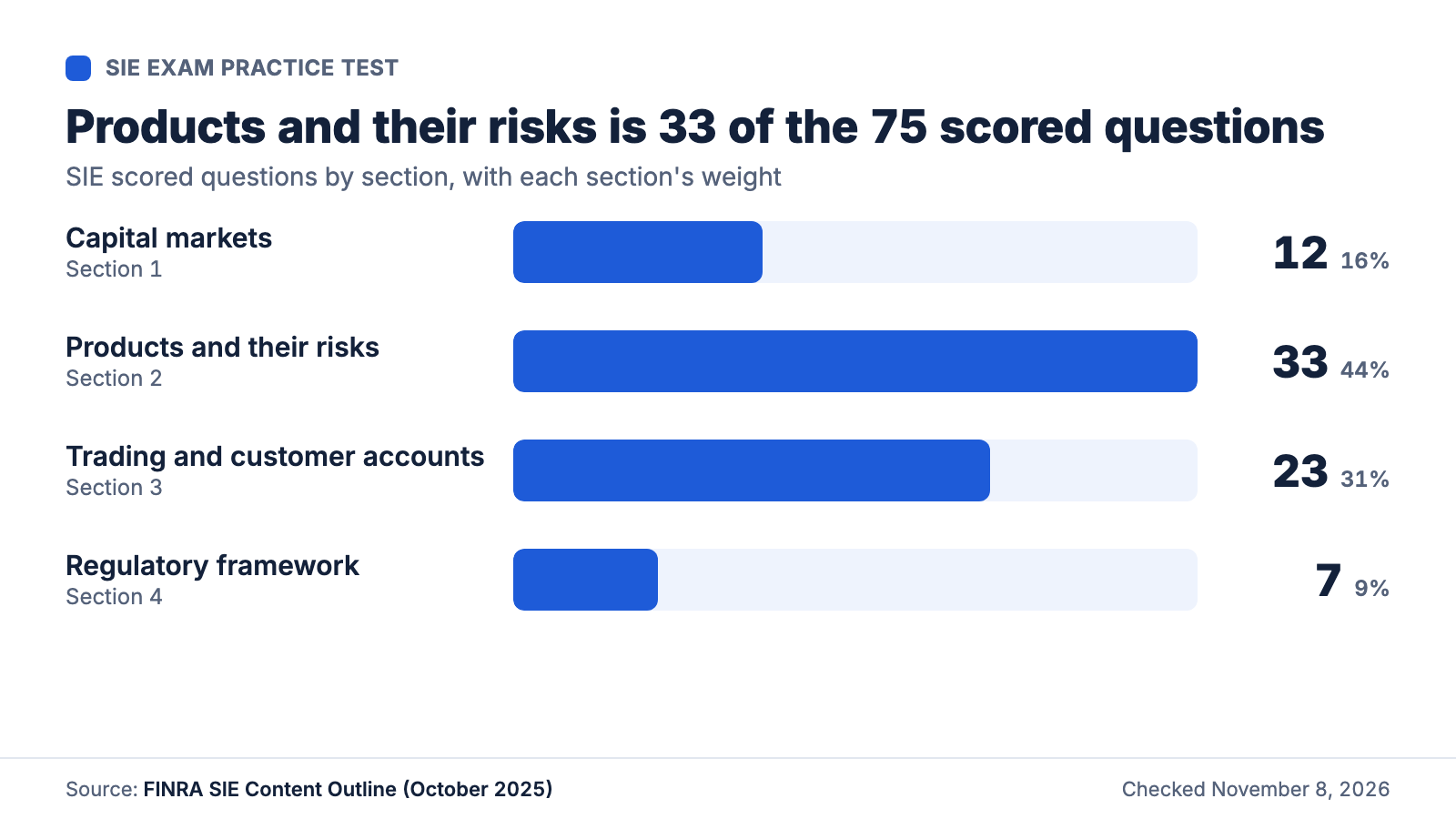
From FINRA's outline: "The exam consists of 75 multiple-choice items, and each item consists of four answer choices." FINRA, SIE Content Outline.
Each exam also includes 5 unscored pretest items, so you answer 80 in total within 1 hour and 45 minutes. The outline states there is no penalty for guessing, so answer every question. The passing score is 70 on a scale of 0 to 100 (FINRA SIE FAQ).
Use this route for each subtopic:
- Read the "What to know" cell and say the idea back in your own words.
- Read the common confusion and explain the difference between the two ideas.
- Answer the sample questions for the section, then drill the section in the practice test.
- Mark any subtopic you missed and come back to it before moving to the next section.
Section 1: Knowledge of Capital Markets (16%, 12 questions)
Section 1 covers who regulates the markets, how markets are structured, how the economy affects securities, and how new securities are offered. Start here, because the regulators and market participants named in this section come up again in the later sections.
| Subtopic | What to know | Common confusion |
|---|---|---|
| 1.1.1 The SEC | The SEC was created by the Securities Exchange Act of 1934. Its mission is to protect investors, maintain fair, orderly and efficient markets, and facilitate capital formation. It registers and oversees brokerage firms, transfer agents, clearing agencies and the self-regulatory organizations. | The SEC requires disclosure to be accurate. It does not guarantee the disclosure or approve an investment's merits. |
| 1.1.2 Self-regulatory organizations (SROs) | FINRA is an SRO for member broker-dealers. It writes and enforces rules for member firms and their representatives, examines firms, administers qualification exams and runs a dispute resolution forum. | FINRA states it is not part of the government. The SEC oversees both FINRA and the MSRB. |
| 1.1.3 Other regulators and agencies | The MSRB writes rules for dealers in municipal securities and regulates municipal advisors. NASAA represents state securities regulators. The Treasury manages the public debt. The Federal Reserve runs monetary policy. SIPC protects customers of failed brokerage firms when assets are missing. FDIC insures bank deposits. | SIPC versus FDIC. SIPC does not protect against a fall in your securities' value. FDIC does not cover non-deposit investment products, even when a bank sells them. |
| 1.1.4 Market participants and their roles | A broker acts as agent and a dealer acts as principal. An investment adviser gives investment advice for compensation. A market maker stands ready to buy or sell at publicly quoted prices. A transfer agent records ownership changes, keeps holder records and distributes dividends. A bond trustee monitors the indenture for bondholders. | An individual who trades only for their own account is generally a trader. A dealer buys and sells as principal as a business. For the accredited investor net worth test, the primary residence is excluded. |
| 1.2.0 Depositories and clearing corporations | DTCC provides post-trade infrastructure. NSCC provides clearing and final settlement instructions, and DTC handles the actual transfer of securities and funds. The OCC is the buyer to every seller and the seller to every buyer in U.S. listed options. | Clearing versus settlement. Clearing matches and novates the trade. Settlement makes it final. |
| 1.2.1 Types of markets | In the primary market, newly issued securities are sold and the issuer receives the proceeds. In the secondary market, existing securities trade between investors. The third market is OTC trading in exchange-listed stocks. The fourth market is trading directly between institutions without an exchange or broker-dealer. | Third market versus fourth market. A broker-dealer is involved in the third market. The fourth market skips both the exchange and the broker-dealer. |
| 1.3.1 Federal Reserve impact on business activity | Monetary policy is the Fed's work: open market operations, the federal funds rate and the discount rate. The FOMC sets the policy stance and meets eight times a year. Congress set the Fed's dual mandate of maximum employment and price stability. | Monetary versus fiscal policy. Fiscal policy (tax and spending) is decided by Congress and the Administration, and the Fed has no role in it. The fed funds rate is what banks charge each other overnight. The discount rate applies to collateralized loans from a Federal Reserve Bank. |
| 1.3.2 Business economic factors | A balance sheet shows what a company owns and owes at one point in time. An income statement shows what it earned and spent over a period. Assets = liabilities + shareholders' equity. Leading indicators point to turning points in the business cycle, and coincident indicators show the current state. Defensive industries sell things people need in any economy. Cyclical industries such as travel move with the economy. | Keynesian versus monetarist. Keynesians treat aggregate demand as the main driver and support active fiscal policy. Monetarists treat the money supply as the chief driver of nominal GDP in the short run. |
| 1.3.3 International economic factors | GDP measures final goods and services produced in the United States. GNP measures output by labor and property supplied by U.S. residents, wherever they are located. The balance of payments records transactions between U.S. and foreign residents. An exchange rate is the price of one currency in another. | GDP versus GNP. Output from a foreign-owned plant located in the United States counts in GDP. Exchange-rate moves can raise or cut the return on an international investment. |
| 1.4.0 Offerings | An IPO is a company's first sale of shares to the public. Regulation D gives exemptions from SEC registration. A shelf registration lets securities be offered on a continuous or delayed basis. Offering documents include the prospectus for registered offerings and the official statement for municipal bonds. Blue-sky laws are state securities laws. | Best efforts versus firm commitment. In a best-efforts deal the underwriters have no commitment to buy the securities. An offering exempt from registration is still subject to the antifraud provisions. |
Sources for Section 1: SEC role, laws that govern the securities industry, About FINRA, market participants, SIPC, FDIC, SEC broker-dealer guide, 17 CFR 230.501, OCC, DTCC, Federal Reserve monetary policy FAQ, SEC guide to financial statements, IMF on Keynesian economics, IMF on monetarism, BEA GDP, BEA GNP, Regulation D offerings, 17 CFR 230.415.
Sample question 1 · Capital markets
Which organization has the federal mission of protecting investors, maintaining fair securities markets, and facilitating capital formation?
- The Federal Deposit Insurance Corporation
- The Securities and Exchange Commission
- The Federal Reserve
- The Internal Revenue Service
Show the answer
Correct: B. The Securities and Exchange Commission
The SEC has this three-part mission. The Federal Reserve focuses on monetary policy and the banking system rather than serving as the federal securities market regulator.
Sample question 2 · Capital markets
Firm S sells 1,000 shares to Firm B on an exchange, and the trade is matched and validated at NSCC. Before settlement date, Firm B defaults. Who is now Firm S's counterparty for completing the trade?
- NSCC, which replaced Firm B as legal counterparty
- Firm B, which remains bound as original counterparty
- The exchange, which guarantees trades matched on it
- DTC, which stands behind every trade it settles
Show the answer
Correct: A. NSCC, which replaced Firm B as legal counterparty
Through novation, NSCC becomes the legal counterparty to each validated trade, so Firm S looks to NSCC for completion. Treating the original buyer as Firm S's counterparty is the strongest misconception, because central clearing exists to remove that exposure. DTC carries out the transfer and the exchange matched the orders, but neither becomes the counterparty.
Drill Section 1 in the SIE practice test once both sample questions make sense.
Section 2: Understanding Products and Their Risks (44%, 33 questions)
Section 2 covers equity, debt, options, funds, 529 and ABLE plans, DPPs, REITs, hedge funds, exchange-traded products and investment risk. It is the largest section, and most of the calculations further down this page come from it.
| Subtopic | What to know | Common confusion |
|---|---|---|
| 2.1.1 Equity securities | Common stock gives the right to vote at shareholder meetings and receive dividends. Preferred stockholders usually cannot vote but receive dividends before common stockholders. An ADR represents one or more shares of a foreign stock, or a fraction of a share, and is issued by a U.S. depositary bank. A rights offering lets existing shareholders buy new shares in proportion to their holdings. Restricted and control securities are resold under SEC Rule 144. | Order of payment in a liquidation. Bondholders are paid first, then preferred stockholders, then common stockholders. |
| 2.1.2 Debt instruments | Treasury bills run 4 to 52 weeks, notes 2, 3, 5, 7 or 10 years, and bonds 20 or 30 years. TIPS principal adjusts with the Consumer Price Index. A debenture is an unsecured bond. Callable bonds let the issuer retire the bond before maturity. When interest rates rise, bond prices tend to fall. | Treasury versus agency backing. Treasurys carry the full faith and credit of the U.S. government. Securities issued by a government-sponsored enterprise do not. For munis, a general obligation bond is backed by the issuer's full faith and credit and a revenue bond by a specific project's revenue. |
| 2.1.3 Options | A call holder has the right to buy the underlying. A put holder has the right to sell it. The writer takes on the obligation to perform if assigned. American-style options can be exercised any time up to expiration. Exercising an index option produces a cash payment. Investors receive the options disclosure document, "Characteristics and Risks of Standardized Options." | Holder versus writer. The holder chooses whether to exercise. The writer must perform if assigned. The loss on an uncovered (naked) call is theoretically unlimited. A covered call is written by someone who owns the stock. |
| 2.1.4 Packaged products | Class A fund shares usually charge a front-end sales charge. Class B shares usually carry a contingent deferred sales charge if sold within a set period. Class C shares have no front-end charge. All classes of a fund hold the same investments. Breakpoints are the purchase amounts at which sales charges drop. A letter of intent commits the investor to buy a stated amount within a set period. | Open-end versus closed-end. A mutual fund continuously sells and redeems shares at a price based on NAV. Most closed-end funds issue a fixed number of shares in an IPO, and those shares then trade on an exchange at market prices. |
| 2.1.5 Municipal fund securities | 529 plans come in two types: prepaid tuition plans and savings plans. Contributions are not deductible for federal tax. Investing in a direct-sold 529 plan can often save you money. ABLE account distributions are tax-free when used for qualified disability expenses. Local government investment pools (LGIPs) pool public money from government entities. | Owner versus beneficiary. The owner opens and controls the 529 account. The beneficiary is the current or future student. |
| 2.1.6 Direct participation programs (DPPs) | A DPP provides flow-through tax treatment. A partnership does not pay income tax itself. Profits and losses pass to the partners. Limited partners are not involved in day-to-day management and have limited liability. DPPs carry risks including loss of investment and lack of liquidity. | FINRA Rule 2310's DPP definition excludes REITs, so a REIT question is a separate subtopic. |
| 2.1.7 REITs | A REIT owns and typically operates income-producing real estate or related assets. Mortgage REITs provide financing to property owners. Some REITs are listed on exchanges. Others are registered with the SEC but not traded, and some are private. | Registered versus listed. A non-traded REIT can be SEC-registered and still be illiquid and hard to value. |
| 2.1.8 Hedge funds | Hedge funds are private funds that may use leverage. Depending on the fund's structure, you must be an accredited investor or qualified purchaser. A lockup period is a time when you cannot cash in shares. Performance fees can motivate managers to take greater risks. | Liquidity after lockup. A fund may still have authority to suspend redemptions under certain circumstances. Hedge funds remain subject to the antifraud prohibitions. |
| 2.1.9 Exchange-traded products (ETPs) | ETF shares trade on exchanges at market prices, with bid-ask spreads. Some ETFs are actively managed. Leveraged and inverse products target geared exposure for a set period, such as one day. | ETF versus ETN. An ETN is an unsecured debt obligation of a bank or other financial institution, so you can lose some or all of your investment if the issuer defaults. |
| 2.2.0 Risk types and mitigation | Inflation cuts purchasing power for fixed-rate income. Interest rate risk: bond prices fall when rates rise. Credit risk: the issuer fails to pay interest or principal. Liquidity risk: no market for the security. Currency risk changes international returns. Diversification spreads money among various investments. | Call risk versus prepayment risk. Both rise when rates fall. A callable bond can be redeemed by its issuer. Mortgage-backed securities return principal early when homeowners refinance. |
The options subtopic has its own question set. Work through the rights and obligations of each side, then practice SIE options questions with explanations.
Sources for Section 2: Investor.gov stocks, ADRs, FINRA corporate actions, FINRA bonds, TreasuryDirect, Investor.gov municipal bonds, FINRA options, FINRA mutual funds, FINRA breakpoints, FINRA closed-end funds, IRS 529 Q&A, IRS ABLE accounts, FINRA Rule 2310, Investor.gov REITs, Investor.gov hedge funds, FINRA ETFs and ETNs, Investor.gov risk.
Sample question 1 · Products and their risks
A customer buys an ADR listed in the United States. What does the receipt represent?
- An interest in shares of a foreign company
- A right to buy any domestic stock at par
- A direct loan to the United States Treasury
- An insured deposit in a foreign central bank
Show the answer
Correct: A. An interest in shares of a foreign company
An ADR represents foreign company shares or a fraction or multiple of them. Trading in the United States does not turn it into a Treasury obligation.
Sample question 2 · Products and their risks
A customer wrote an XYZ call that is now deep in the money. XYZ goes ex-dividend tomorrow, and the call does not expire for another month. Which risk should the customer recognize?
- Early assignment grows more likely as holders seek the dividend.
- Assignment risk falls because holders prefer to keep their time value.
- Assignment cannot occur until the call's expiration date arrives.
- The dividend lowers the strike and removes the call's intrinsic value.
Show the answer
Correct: A. Early assignment grows more likely as holders seek the dividend.
Call holders may exercise before the ex-dividend date to become stockholders and capture the dividend, so the writer's chance of early assignment rises. The belief that assignment waits for expiration ignores that equity options are American-style and can be exercised at any time.
Sample question 3 · Products and their risks
A city places tax receipts it will need for payroll over the coming months into a local government investment pool (LGIP). According to the MSRB's glossary, what does the pool's investment advisor invest in line with?
- The ages of the participants' designated beneficiaries
- The long-term retirement horizon of public employees
- The cash management needs of its participants
- The trade instructions each participant submits
Show the answer
Correct: C. The cash management needs of its participants
The MSRB's glossary says an LGIP's investment advisor invests consistent with the cash management needs of its governmental participants. Beneficiary ages are the strongest wrong answer because they drive age-based 529 options, which serve individual education accounts and not public treasuries.
Sample question 4 · Products and their risks
A hedge-fund investor has completed the initial lockup. Which contractual provision could still permit the fund to delay an otherwise eligible redemption request?
- Terms authorizing suspension of redemptions under specified conditions
- Terms specifying how NAV is calculated for an accepted redemption
- Terms setting the fee charged on a completed redemption
- Terms naming the currency in which redemption proceeds are paid
Show the answer
Correct: A. Terms authorizing suspension of redemptions under specified conditions
Hedge-fund terms can authorize redemption suspensions, including during market stress or difficulty selling investments. A NAV-calculation provision determines valuation; it does not by itself establish when a redemption request must be honored.
Drill Section 2 in the SIE practice test, then work the calculations further down this page.
Section 3: Understanding Trading, Customer Accounts and Prohibited Activities (31%, 23 questions)
Section 3 covers orders, returns, settlement, corporate actions, account types and registrations, anti-money laundering, records, communications and prohibited conduct.
| Subtopic | What to know | Common confusion |
|---|---|---|
| 3.1.1 Orders and strategies | A market order executes at the current market price. A buy limit executes at the limit price or lower, and a sell limit at the limit price or higher. An IOC order cancels any part not filled immediately. A fill-or-kill order fills in full immediately or cancels. Short sellers expect the price to fall. | Stop versus limit. When the stop price is reached, a stop order becomes a market order, so the fill can differ from the stop price in a fast market. |
| 3.1.2 Investment returns | A cash dividend pays money per share and a stock dividend pays additional shares. The record date sets who is on the company's books to receive the dividend. Current yield, yield to maturity and yield to call are covered in the math sections below. A basis point is 0.01 of a percentage point. | Record date versus ex-dividend date. If you buy on or after the ex-dividend date, the seller gets the dividend. |
| 3.1.3 Trade settlement | Most U.S. securities transactions settle T+1, one business day after the trade date. The firm must receive payment no later than one business day after execution. Book-entry form means no paper certificate is issued. | Starting an ACH transfer does not meet the payment requirement. The funds must be deposited in the brokerage firm's bank account. |
| 3.1.4 Corporate actions | A stock split increases the share count without changing shareholders' equity. A reverse split reduces the share count and raises the price per share. A tender offer is a widespread offer to buy a substantial percentage of a company's securities. A proxy lets shareholders vote without attending the meeting. | Merger versus acquisition. A merger joins two companies into one entity. An acquisition is one company buying a majority of another's stock. |
| 3.2.1 Account types | In a cash account you pay the full amount for purchases. A margin account lets you borrow from the firm against the account, and it is the only account type for short selling. A wrap (fee-based) account charges fees generally based on the account's total market value. | Discretion. A representative needs prior written authorization from the customer, accepted in writing by the firm, to choose the security or amount. Choosing only the time or price for a definite order the customer gave is a narrower exception. |
| 3.2.2 Customer account registrations | Registrations include individual, joint, corporate, trust, custodial and partnership accounts, plus IRAs and qualified plans. The 2026 IRA contribution limit is $7,500. Required minimum distributions start at age 73. A trusted contact person has no authority to act on the account. | Traditional versus Roth IRA. Traditional contributions may be deductible and are taxed on withdrawal. Roth contributions are not deductible, qualified distributions are tax-free, and Roth IRAs have no RMDs during the owner's life. |
| 3.2.3 Anti-money laundering (AML) | Money laundering disguises assets so they can be used without detection of the illegal activity behind them. Structuring is itself unlawful under the Bank Secrecy Act. Each firm's AML program must be approved in writing by senior management. OFAC blocks the property of listed persons, and U.S. persons generally may not deal with them. | CTR versus SAR. A CTR covers cash transactions over $10,000 in a day. A broker-dealer SAR covers suspicious transactions of at least $5,000. A SAR is confidential and must not be disclosed to the customer. |
| 3.2.4 Books and records and privacy | Firms must send account statements at least once every calendar quarter and a confirmation for each transaction under SEA Rule 10b-10. Account opening records are kept at least six years after the account closes. Each firm needs a written business continuity plan. Regulation S-P requires a privacy notice and safeguards for customer information. | Under Regulation S-P, customers get a reasonable opportunity to opt out before their information is shared with a nonaffiliated third party. |
| 3.2.5 Communications, best interest and suitability | Regulation Best Interest requires a broker-dealer to act in the retail customer's best interest when recommending, without putting its own interest first. Firms must deliver Form CRS to retail investors. FINRA Rule 2090 requires reasonable diligence to know the essential facts about every customer. Communications must be fair and balanced. | Form CRS timing. A broker-dealer delivers it before or at the earliest of a recommendation, an order or opening an account. |
| 3.3.1 Market manipulation | Pump and dump: false hype raises a price, then the promoters sell. Churning is excessive trading mainly to generate commissions. Trades made to create a false appearance of activity are prohibited. A firm must honor its quoted prices, and failing to do so is backing away. Freeriding is buying and selling in a cash account before paying. | Front running uses material nonpublic market information about an imminent block transaction. A block is generally 10,000 shares or more. |
| 3.3.2 Insider trading | Illegal insider trading is buying or selling on material nonpublic information in breach of a duty of trust. Tipping the information and trading by the person tipped are also violations. | Tipper versus tippee. Both can violate the law, and so can someone who misappropriates information from an employer, family or friends. |
| 3.3.3 Other prohibited activities | Firms and associated persons may not make improper use of customer funds or securities. They may not guarantee a customer against loss. Borrowing from or lending to customers needs firm procedures and written approval. A firm may place a temporary hold on a disbursement from a specified adult's account when exploitation is suspected. | Sharing in an account is allowed only in direct proportion to your own financial contribution, with the required approvals. |
Sources for Section 3: Investor.gov orders glossary, ex-dividend dates, basis point, FINRA settlement cycles, SEC T+1 release, stock split, FINRA brokerage accounts, FINRA Rule 3260, IRS 2026 limits, IRS RMDs, IRS Roth IRAs, FinCEN, 31 CFR 1010.311, 31 CFR 1023.320, FINRA Rule 3310, OFAC SDN FAQ, FINRA Rule 2231, 17 CFR 240.17a-4, FINRA Rule 4370, Regulation S-P, Regulation Best Interest, Form CRS guide, FINRA Rule 5270, insider trading, FINRA Rule 2150, FINRA Rule 3240, FINRA Rule 2165.
Sample question 1 · Trading and customer accounts
A stock gaps sharply downward through a customer's sell stop price. Which outcome is possible after the order triggers?
- Conversion into a buy limit order
- Automatic cancellation of every stop order
- A guaranteed sale at the stop price
- Execution below the stop price
Show the answer
Correct: D. Execution below the stop price
A triggered standard stop executes as a market order and may fill below the stop price in a fast market. The stop price is not a guaranteed minimum sale price.
Sample question 2 · Trading and customer accounts
A customer submits a 500-share IOC buy limit at $20. Only 200 shares can immediately be purchased at $20; additional offers are $20.10. Which outcome respects both instructions?
- Cancel the entire order because IOC never permits a partial fill.
- Buy 200 shares now and keep the balance open until the limit becomes available.
- Buy the 200 available shares at $20 and cancel the unfilled balance.
- Buy all 500 shares by paying $20.10 for the balance.
Show the answer
Correct: C. Buy the 200 available shares at $20 and cancel the unfilled balance.
IOC permits an immediate partial fill but cancels the remainder, while the buy limit prohibits paying above $20. The higher offer cannot be used simply to complete the requested quantity.
Sample question 3 · Trading and customer accounts
A customer applying for options trading asks why her firm approves accounts for a specific level instead of allowing every strategy. According to FINRA's investor guidance, what is this policy designed to do?
- Keep customers from trading beyond their abilities or means
- Keep customers from losing more than the premium they pay
- Keep firms from having to supervise options accounts
- Keep customers' positions within exchange position limits
Show the answer
Correct: A. Keep customers from trading beyond their abilities or means
FINRA says the approval policy is designed to protect investors from trading beyond their abilities or financial means, and to protect firms against potential defaults on margin accounts. Approval does not cap her losses at the premium, since FINRA warns that options trading can carry a significant risk of loss beyond the initial investment.
Drill Section 3 in the SIE practice test, and pay attention to which account or rule each scenario points to.
Section 4: Overview of the Regulatory Framework (9%, 7 questions)
Section 4 covers registration, continuing education, Forms U4 and U5, and the outside activities and events a representative must report. It is the smallest section, and its subtopics center on filings, notices and deadlines.
| Subtopic | What to know | Common confusion |
|---|---|---|
| 4.1.1 Registration and continuing education | A representative must pass the SIE and an appropriate representative qualification exam. Anyone who accepts customer orders must be registered. Persons in solely clerical or ministerial roles are exempt. Continuing education has a Regulatory Element, due annually by December 31, and a Firm Element based on the firm's written training plan. An SIE pass is valid for four years. | Passing the SIE alone does not qualify you as a representative. You must also pass an appropriate representative qualification exam. |
| 4.2.1 Employee conduct | Form U4 is the Uniform Application for Securities Industry Registration or Transfer. Amendments are due within 30 days of learning the facts, or 10 days after a statutory disqualification. Form U5, the termination notice, is due within 30 days of the employment end date, and the person gets a copy. Filing incomplete or inaccurate information that is misleading is prohibited. | U4 versus U5. The U4 registers and is kept current. The U5 reports the end of association. |
| 4.2.2 Reportable events | An outside business activity needs prior written notice to the firm, and passive investments are exempt. A private securities transaction needs prior written notice. If you will be compensated, the firm must approve it and supervise it as its own. FINRA's gift limit is $300 per person per year. Under MSRB Rule G-37, the de minimis contribution is $250 per election to an official you can vote for. | Outside business activity versus private securities transaction. An outside activity is a job or business outside the firm. A private securities transaction is selling a security away from the firm. |
Sources for Section 4: FINRA Rule 1210, FINRA Rule 1230, FINRA Rule 1240, FINRA SIE FAQ, Form U4, FINRA By-Laws Article V, Form U5, FINRA Rule 1122, FINRA Rule 3270, FINRA Rule 3280, Regulatory Notice 26-05, MSRB Rule G-37.
Sample question 1 · Regulatory framework
A representative buys a passive interest in a business and takes no operating role. How does Rule 3270 treat passive investments?
- It exempts passive investments from that outside business notice requirement
- It requires the business to become a FINRA member
- It categorically prohibits all passive investments
- It treats every passive holding as employment
Show the answer
Correct: A. It exempts passive investments from that outside business notice requirement
Rule 3270 expressly exempts passive investments from its requirement. That exemption should not be stretched to cover an active, compensated business role.
Drill Section 4 in the SIE practice test. When all four sections are done, take the timed full exam.
Take the timed SIE practice exam
Choose useful free materials
Free SIE materials include FINRA's content outline, FINRA's practice test, the official investor pages behind each concept, and original practice questions. FINRA itself points candidates to the outline.
From FINRA's FAQ: "The content outline is available on FINRA.org. While FINRA does not endorse the materials created by any particular vendor, a number of test providers have created materials." FINRA, SIE and Exam Restructuring FAQ.
Pick each material for the job it does:
| What you need | Material | Where |
|---|---|---|
| The full list of tested topics | SIE Content Outline (PDF) | FINRA |
| One 75-question check of exam-style questions | FINRA's SIE practice test (not timed) | FINRA |
| The source behind a concept | FINRA investor pages and the SEC's Investor.gov glossary | Linked in each section above |
| Short explanations in outline order | This study guide | This page |
| Questions with explanations, by section | Original practice questions | SIE practice test |
| Recall of terms and distinctions | Flashcards | SIE Flashcards |
| A definition you met in a question | Glossary | SIE Exam Vocabulary |

Flashcards test whether you can retrieve a fact from memory. Explanations teach why it is true. Use the guide first for a new subtopic, then flashcards to keep it.
From FINRA's practice test page: "Answer 75 multiple-choice questions that are similar to those you might find on the SIE exam." FINRA, Practice Test for the SIE.
FINRA notes that its practice test is not timed, and that your score on it is not an absolute prediction of your SIE result.
Concise rule and formula review
This review sheet lists the numbers and formulas the SIE outline expects you to apply, each with its official source. You cannot take it into the exam.
From FINRA's outline: "Candidates are not permitted to bring reference materials to their testing session." FINRA, SIE Content Outline.
Use the sheet for a last review the day before, and test yourself on each row by covering the value column.
| Rule or fact | Value | Source |
|---|---|---|
| SIE format | 75 scored plus 5 unscored items, 1 hour 45 minutes | FINRA outline |
| SIE passing score | 70 on a 0 to 100 scale | FINRA FAQ |
| Standard settlement | T+1 since May 28, 2024 | SEC |
| Regulation T initial margin | 50% of current market value | 12 CFR 220.12 |
| FINRA maintenance margin, long | 25% of current market value | FINRA Rule 4210 |
| Minimum equity in a margin account | $2,000 (no cash needed beyond the cost of the purchase) | FINRA Rule 4210 |
| SIPC protection | $500,000, including $250,000 for cash | SIPC |
| FDIC insurance | $250,000 per depositor, per insured bank, per ownership category | FDIC |
| Currency transaction report (CTR) | Cash over $10,000 | 31 CFR 1010.311 |
| Broker-dealer SAR | At least $5,000 | 31 CFR 1023.320 |
| Mutual fund sales charge cap | 8.5% of the offering price | FINRA Rule 2341 |
| 12b-1 fees | Asset-based sales charge up to 0.75% a year, service fee up to 0.25% | FINRA Rule 2341 |
| Rule 144 holding period | 6 months (reporting issuer), 1 year (non-reporting issuer) | 17 CFR 230.144 |
| Accredited investor | Net worth over $1,000,000 excluding primary residence, or income over $200,000 in each of the 2 most recent years | 17 CFR 230.501 |
| Treasury maturities | Bills 4 to 52 weeks; notes 2, 3, 5, 7 or 10 years; bonds 20 or 30 years | TreasuryDirect |
| IRA contribution limit, 2026 | $7,500, plus $1,100 catch-up at age 50 or over | IRS |
| Required minimum distributions | Start at age 73 | IRS |
| Account statements | At least once every calendar quarter | FINRA Rule 2231 |
| Form U4 amendment | Within 30 days (10 days for a statutory disqualification) | FINRA By-Laws |
| Form U5 | Within 30 days of the employment end date | FINRA |
| CE Regulatory Element | Annually by December 31 | FINRA Rule 1240 |
| FINRA gift limit | $300 per person per year | Regulatory Notice 26-05 |
| MSRB G-37 de minimis contribution | $250 per election, where you can vote for the official | MSRB Rule G-37 |
| Basis point | 0.01 of a percentage point (8% = 800 basis points) | Investor.gov |
Two rules changed in 2026, so older study material may show the earlier figure. FINRA raised the gift limit from $100 to $300, effective March 30, 2026. FINRA's intraday margin standards replace the pattern day trader $25,000 minimum equity rule.
From FINRA Regulatory Notice 26-10: "Effective Date: June 4, 2026; Phase-in Period: Ends October 20, 2027". FINRA, Regulatory Notice 26-10.
The formulas, each worked step by step in the sections below:
| Calculation | Formula |
|---|---|
| Current yield | Annual interest / market price |
| Tax-equivalent yield | Tax-exempt yield / (1 - tax rate) |
| Conversion ratio | Par value / conversion price |
| Conversion value | Conversion ratio x stock price |
| Parity price of the stock | Bond market price / conversion ratio |
| NAV per share | (Total assets - total liabilities) / shares outstanding |
| Public offering price (POP) | NAV / (1 - sales charge %) |
| Sales charge % | (POP - NAV) / POP |
| Margin equity | Market value - debit balance |
| Stock split | New shares = old shares x split ratio; new price = old price / split ratio |
Solve SIE calculations with units and steps
SIE math uses a handful of formulas, and each one depends on the right denominator. Every calculation below names its denominator, works one original example with units, checks the answer a second way, and shows the wrong method that produces a tempting answer.
At a test center, FINRA provides the calculator.
From FINRA's test center page: you are provided "four-function calculator, erasable note boards, dry-erase markers". FINRA, Prepare for Your Test Center Appointment.
Use the same habits on every calculation:
- Write the units next to each number (dollars, shares, percent).
- Name the denominator before you divide.
- Check the answer with a second method or by working backward.
- Ask whether the answer is sensible, for example whether a discount bond's current yield is above its coupon rate.
| Calculation | Divide by | Common wrong denominator |
|---|---|---|
| Current yield | Market price | Par value |
| Tax-equivalent yield | (1 - tax rate) | Multiplying by (1 + tax rate) |
| Parity price | Conversion ratio, using the bond's market price | Par value |
| POP from NAV | (1 - sales charge %) | Multiplying NAV by (1 + sales charge %) |
| Sales charge % | POP | NAV |
Current yield
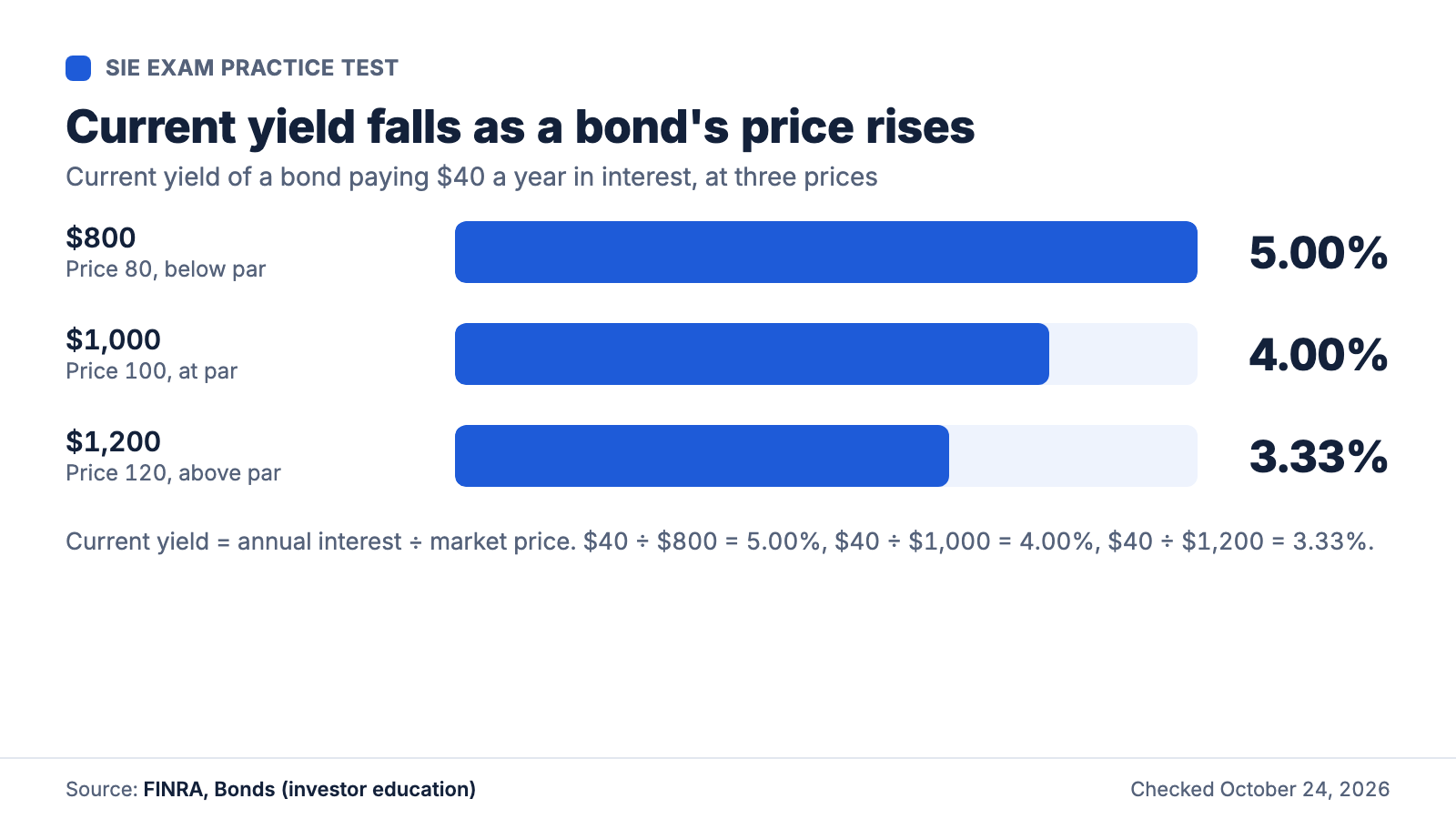
Current yield is the bond's annual interest in dollars divided by its current market price. When the price changes, the current yield changes with it.
From FINRA: "Current yield is the yearly coupon payment divided by the bond's price, stated as a percent." FINRA, Bonds.
Bond prices are quoted as a percentage of par. FINRA's example: a bond quoted at 105 trades at 105% of par, or $1,050.
Worked example. A $1,000 par bond pays a 4% coupon and is quoted at 80.
- Annual interest: $1,000 x 0.04 = $40 a year.
- Market price: 80% of $1,000 = $800.
- Current yield: $40 / $800 = 0.05 = 5.00%.
Check. 5% of $800 is $40, the annual interest. The bond trades below par, so its current yield (5.00%) is above its coupon rate (4%).
Wrong method. Dividing $40 by the $1,000 par value gives 4%. That is the coupon rate, also called the nominal yield.
Coupon, price and yield relationships
A bond's price and its yield move in opposite directions. When market interest rates rise, the price of an existing bond falls until its yield matches the market.
From FINRA: "Price and yield are inversely related: As the price of a bond goes up, its yield goes down, and vice versa." FINRA, Understanding Bond Yield and Return.
FINRA's own example uses a $1,000 bond with a 6% coupon bought at face value. If a comparable new bond later pays 7%, you "might need to offer it at a price below face value because investors would now expect to be making a 7 percent return" (FINRA, Brush Up on Bonds).
Yield to maturity is the overall rate earned by buying at the market price and holding to maturity, counting both the coupons and the repayment of par. Yield to call uses the call date and call price instead. The coupon never changes, so only the price and the yields move.
| Bond price | Name | Current yield compared with the coupon rate | Yield to maturity compared with the current yield |
|---|---|---|---|
| Below par | Discount | Higher | Higher, because you also gain the discount at maturity |
| At par | Par | Equal | Equal |
| Above par | Premium | Lower | Lower, because you lose the premium at maturity |
Worked example. A $1,000 par bond with a 5% coupon pays $50 a year. At $1,250 (a premium), current yield is $50 / $1,250 = 4.00%. The bond repays only $1,000 at maturity, so the $250 premium is lost and the yield to maturity is below 4.00%.
Check. Premium bond: coupon rate (5%) is above current yield (4%), which is above yield to maturity. The order runs the other way for a discount bond.
Wrong method. Saying the coupon rate falls when the price rises. The coupon is fixed at issuance and tied to par.
Tax-equivalent yield
The tax-equivalent yield is the taxable yield that leaves you with the same after-tax income as a tax-exempt bond: divide the tax-exempt yield by (1 - your tax rate). The question gives you the tax rate as an assumption. You do not need to memorize a tax bracket.
From FINRA: municipal bonds "are typically exempt from federal taxation and, for investors who reside in the state where the bond is issued, from state and local taxes, too." FINRA, Bonds.
Worked example. A municipal bond yields 3.00%, its interest is exempt from federal income tax, and you assume a 25% federal tax rate with no state tax.
- Keep share after tax: 1 - 0.25 = 0.75.
- Tax-equivalent yield: 3.00% / 0.75 = 4.00%.
Check. A taxable bond yielding 4.00% loses 25% to tax: 4.00% x 0.75 = 3.00% after tax, the same as the municipal bond.
Wrong methods. Multiplying 3.00% by 0.75 gives 2.25%. That taxes income that is already exempt. Multiplying by 1.25 gives 3.75%, which is too low because the tax comes out of the taxable yield.
Conversion ratio, conversion value and parity
The conversion ratio is the number of shares one convertible bond buys: par value divided by the conversion price. Conversion value and parity both build on that ratio.
From FINRA: "A convertible bond is a bond with the option to convert into shares of common stock of the same issuer at a pre-established price." FINRA, Bonds.
Worked example. A $1,000 par convertible bond has a conversion price of $50 per share. The stock trades at $56 and the bond trades at $1,080.
- Conversion ratio: $1,000 / $50 = 20 shares per bond.
- Conversion value: 20 shares x $56 = $1,120.
- Parity price of the stock: $1,080 / 20 shares = $54 per share.
Check. At $54 a share, 20 shares are worth 20 x $54 = $1,080, the bond's market price. The stock now trades at $56, above parity, so converting gives shares worth $1,120 against a bond worth $1,080.
Wrong methods. Dividing par by the stock price ($1,000 / $56) mixes up the conversion price with the market price. Dividing par instead of the bond's market price by the ratio ($1,000 / 20 = $50) returns the conversion price, which differs from parity.
NAV, offering price and load denominators
Net asset value (NAV) per share is a fund's total assets minus total liabilities, divided by the shares outstanding. The public offering price (POP) adds the front-end sales charge, which is stated as a percentage of the POP.
From Investor.gov: NAV is "the company's total assets minus its total liabilities." SEC, Net Asset Value.
From FINRA Rule 2341: "A 'front-end sales charge' is a sales charge that is included in the public offering price of the shares of an investment company." FINRA, Rule 2341.
Worked example. A fund holds $66 million in assets and owes $6 million, with 4 million shares outstanding. A second fund has a NAV of $14.10 and a 6% front-end sales charge.
- First fund NAV: ($66,000,000 - $6,000,000) / 4,000,000 shares = $15.00 per share.
- Second fund: NAV is 94% of the POP, because the charge is 6% of the POP.
- POP: $14.10 / (1 - 0.06) = $14.10 / 0.94 = $15.00.
Check. 6% of $15.00 is $0.90, and $15.00 - $0.90 = $14.10, the NAV.
Wrong method. $14.10 x 1.06 = $14.95. That treats the charge as a percentage of NAV, so the POP comes out too low.
Sales charge percentage and invested dollars
The sales charge percentage is the dollar charge divided by the public offering price. The money left after the charge buys shares at NAV.
FINRA Rule 2341 caps aggregate front-end and deferred sales charges at 8.5% of the offering price for funds without an asset-based sales charge.
Worked example. A fund's POP is $15.00 and its NAV is $14.10. You invest $6,000.
- Charge per share: $15.00 - $14.10 = $0.90.
- Sales charge %: $0.90 / $15.00 = 0.06 = 6%.
- Charge on your purchase: $6,000 x 0.06 = $360.
- Invested at NAV: $6,000 - $360 = $5,640.
- Shares bought: $5,640 / $14.10 = 400 shares.
Check. $6,000 / $15.00 POP = 400 shares, the same count.
Wrong method. $0.90 / $14.10 = 6.38%. That divides by NAV, and the rule states the charge as a percentage of the offering price.
Breakpoints lower the percentage at larger purchase amounts. Under one of Rule 2341's rights-of-accumulation schedules, the maximum aggregate charge is 7.75% on purchases of $10,000 or more and 6.25% on purchases of $25,000 or more.
Initial margin versus maintenance and equity
Initial margin is the 50% deposit Regulation T requires on a new margin purchase. Maintenance margin is the 25% of market value FINRA requires the account to keep afterward. Equity is the market value minus the debit balance (the loan).
From 12 CFR 220.12: the margin required is "50 percent of the current market value of the security." eCFR, Regulation T.
From FINRA Rule 4210: the maintenance margin is "25 percent of the current market value of all margin securities" held long. FINRA, Rule 4210.
Worked example. You buy 400 shares at $50 in a margin account.
- Purchase: 400 x $50 = $20,000.
- Initial margin at 50%: $10,000 deposit. Debit balance: $10,000.
- The price falls to $35. Market value: 400 x $35 = $14,000.
- Equity: $14,000 - $10,000 = $4,000.
- Maintenance requirement: 25% x $14,000 = $3,500. Equity of $4,000 is above it, so no maintenance call yet.
Check. Equity reaches 25% of market value when the market value is $10,000 / 0.75 = $13,333.33. At that value, equity is $3,333.33, which is 25% of $13,333.33.
Wrong methods. Using the 50% initial requirement to test for a maintenance call. Taking 25% of the original $20,000 purchase price instead of the current market value.
Firms may set higher margin requirements. Rule 4210 requires firms to "formulate their own margin requirements". A margin account also needs equity of at least $2,000, except that cash need not be deposited beyond the cost of the securities purchased.
Stock splits and cost basis
A stock split changes your share count and the price per share, while your total value and total cost basis stay the same.
From Investor.gov: a stock split is "An increase in the number of shares of a corporation's stock without a change in the shareholders' equity." SEC, Stock Split.
From IRS Publication 550: "if you receive more stock from nontaxable stock dividends or stock splits, you must reduce the basis of your original stock." IRS, Publication 550, checked November 4, 2026.
Worked example (forward split). You own 150 shares bought at $90, a total cost basis of $13,500. The company declares a 3-for-2 split.
- New shares: 150 x 3/2 = 225 shares.
- New price: $90 x 2/3 = $60 per share.
- Basis per share: $13,500 / 225 = $60.
Check. 225 x $60 = $13,500, the same total as before the split.
Worked example (reverse split). You own 500 shares at $2, worth $1,000. The company does a 1-for-5 reverse split: 500 / 5 = 100 shares at $2 x 5 = $10, still $1,000.
Wrong method. Keeping the old $90 basis per share after the split. That overstates your total basis as 225 x $90 = $20,250.
Compare SIE prep options
Compare SIE prep options on whether they match the current FINRA outline and current rules, how much timed practice they give, and what each costs. FINRA does not endorse any vendor's materials, as its FAQ quoted above states.
Commercial providers such as Kaplan, STC, Knopman Marks, PassMasters and Achievable sell SIE preparation.
| What to check | Why it matters for the SIE |
|---|---|
| Outline version | The current FINRA outline is dated 2025. Material built on an older outline can miss topics. |
| Rule dates | The gift limit ($300 from March 30, 2026) and intraday margin standards (from June 4, 2026) changed in 2026. |
| Full-length timed practice | The SIE has 75 scored questions in 1 hour 45 minutes. Check for full timed tests weighted by section. |
| Explanations | Check that each answer explains the wrong choices as well as the right one. |
| Access period and refund terms | Check how long access lasts and when a refund applies before you pay. |
| Price | Compare what each price includes: reading material, question bank, video, or a bundle. |
Each provider's own pages showed the terms below. Prices were checked on November 8, 2026.
| Provider | Price shown | What it includes | Access | Refund terms |
|---|---|---|---|---|
| Kaplan | Basic $99, Essential $149, Premium OnDemand $199, Premium Live Online $229 | Essential: License Exam Manual, QBank, unit videos, checkpoint, midterm and practice exams. Premium adds an OnDemand or Live Online class. | 5 months; a 5-month extension costs $49 | Web-based courses: within 30 days of purchase, only if not accessed, less a $20 fee |
| STC | Digital E-Course $129, Premier $141, Premier Plus $293 | All three: online manual, flashcards, simulated final exams, chapter quizzes, 23 hours of on-demand lectures. Premier and Premier Plus add a printed manual. Premier Plus adds a live virtual class. | 6 months | Online courses: within 30 days of purchase. An accessed course or package is non-refundable. Packages with printed textbooks carry a $50 fee. |
| Knopman Marks | Gold $265, Platinum $495, Diamond $895 | Gold: video lectures, textbook, practice quizzes, benchmark exams, flashcards. Platinum adds unlimited live classes and AI study support. Diamond adds a dedicated faculty advisor. | Until you pass or 1 year, whichever comes first | Within 30 days of delivery, with physical materials unopened and no more than 5% of digital resources used. A $20 fee applies to orders with physical materials. |
| PassMasters | $149 | PDF study manual, over 15 hours of video, topic quizzes, section exams, a final exam, over 2,000 practice and final exam questions | 90 days; each extra 90 days costs $49 | Within 30 days of purchase, only if not accessed, less a $20 fee |
| Achievable | $99, one-time payment | 40 full-length practice exams, 3,800+ practice questions with explanations, online textbook, 36+ video lessons, audio narration | 1 year | Pass guarantee refund if you passed one of its full-length practice exams in the standard time and then failed the SIE. Other refunds are case by case. |
Sources: Kaplan SIE packages, Kaplan return policy, STC SIE packages, STC refund policy, Knopman Marks SIE course, Knopman Marks terms, PassMasters SIE course, PassMasters terms, Achievable SIE course, Achievable FAQ. Checked November 8, 2026.
Compare SIE books and editions
Compare SIE books by publication date, format and what the publisher says each title is for. Publisher pages showed the details below on November 8, 2026.
| Title | Publisher | Date shown | Displayed price |
|---|---|---|---|
| SIE Exam 2027/2028 For Dummies | Wiley (Steven M. Rice) | June 2026, 400 pages (e-book May 2026) | Paperback $31.99, e-book $19.00 |
| SIE Exam: 1001 Practice Questions For Dummies | Wiley (Steven M. Rice) | June 2023, 336 pages (paperback August 2023) | Paperback $29.99, e-book $18.00 |
| SIE License Exam Manual, 4th Edition | Kaplan Financial Education | Fourth edition; date not shown | Print $45; audiobook edition $45 |
Sources: Wiley guide, Wiley question book, Kaplan study tools. Checked November 8, 2026.
Wiley presents the 2027/2028 guide as general exam prep with practice tests and online flashcards, and the 1001 title as extra question practice. Check any number you study against the rule review table above.
SIE study guide PDF
A printable version of this study guide carries the same outline route, explanations and worked calculations for offline study.
SIE practice exam PDF
10 original questions with a separate answer key and explanations
The PDF is free and needs no account.
To test yourself on paper after studying, use the printable SIE practice exam with its separate answer key.