
SIE Exam Vocabulary
This SIE vocabulary list defines 26 terms and term groups from FINRA's SIE content outline, sorted into the outline's four sections. Each entry gives a plain definition, a short example, the term it is most often confused with, the official source and the outline topic where you meet it. When a term is clear, test it in a free SIE practice test.
Sources: FINRA SIE Content Outline (October 2025 version), SEC, Investor.gov, FINRA rules, MSRB, IRS and TreasuryDirect pages named under each entry. Checked October 24 to November 8, 2026.

Find a SIE term definition
Find a term by its outline section: the SIE content outline splits the 75 scored questions into four sections, and this glossary follows the same order. Products terms take the most space because Section 2 carries 44% of the scored items.
| Outline section | Share of scored items | Scored items | Terms on this page |
|---|---|---|---|
| 1. Knowledge of Capital Markets | 16% | 12 | Regulation & Regulators, FINRA, MSRB, Red Herring, Trading, Markets & Economy |
| 2. Understanding Products and Their Risks | 44% | 33 | Equity Securities, Rule 144, Debt Securities, TIPS, Options & Derivatives, Funds & Packaged Products, POP, 12b-1 Fee, CDSC, Letter of Intent, Accumulation Unit |
| 3. Understanding Trading, Customer Accounts and Prohibited Activities | 31% | 23 | Ex-Dividend Date, Best Execution, Accounts, Tax & Retirement, Margin Account, RMD, Freeriding, MNPI |
| 4. Overview of the Regulatory Framework | 9% | 7 | Compliance & Conduct, CRD Number, FINRA Rule 3220 Gift Limit |
| Total | 100% | 75 | 26 entries |
FINRA content outline: "Much of the content on the SIE outline is based on common securities industry knowledge and general concepts." SIE Content Outline. Checked October 24, 2026.
Each entry names the outline topic where the term is tested. Study the SIE outline topic by topic, then check yourself. Try these sample questions, which use five of the terms below:
Sample question 1 · Capital markets
Which organization has the federal mission of protecting investors, maintaining fair securities markets, and facilitating capital formation?
- The Federal Deposit Insurance Corporation
- The Securities and Exchange Commission
- The Federal Reserve
- The Internal Revenue Service
Show the answer
Correct: B. The Securities and Exchange Commission
The SEC has this three-part mission. The Federal Reserve focuses on monetary policy and the banking system rather than serving as the federal securities market regulator.
Sample question 2 · Products and their risks
A customer buys an ADR listed in the United States. What does the receipt represent?
- An interest in shares of a foreign company
- A right to buy any domestic stock at par
- A direct loan to the United States Treasury
- An insured deposit in a foreign central bank
Show the answer
Correct: A. An interest in shares of a foreign company
An ADR represents foreign company shares or a fraction or multiple of them. Trading in the United States does not turn it into a Treasury obligation.
Sample question 3 · Products and their risks
A customer wrote an XYZ call that is now deep in the money. XYZ goes ex-dividend tomorrow, and the call does not expire for another month. Which risk should the customer recognize?
- Early assignment grows more likely as holders seek the dividend.
- Assignment risk falls because holders prefer to keep their time value.
- Assignment cannot occur until the call's expiration date arrives.
- The dividend lowers the strike and removes the call's intrinsic value.
Show the answer
Correct: A. Early assignment grows more likely as holders seek the dividend.
Call holders may exercise before the ex-dividend date to become stockholders and capture the dividend, so the writer's chance of early assignment rises. The belief that assignment waits for expiration ignores that equity options are American-style and can be exercised at any time.
Sample question 4 · Trading and customer accounts
A customer applying for options trading asks why her firm approves accounts for a specific level instead of allowing every strategy. According to FINRA's investor guidance, what is this policy designed to do?
- Keep customers from trading beyond their abilities or means
- Keep customers from losing more than the premium they pay
- Keep firms from having to supervise options accounts
- Keep customers' positions within exchange position limits
Show the answer
Correct: A. Keep customers from trading beyond their abilities or means
FINRA says the approval policy is designed to protect investors from trading beyond their abilities or financial means, and to protect firms against potential defaults on margin accounts. Approval does not cap her losses at the premium, since FINRA warns that options trading can carry a significant risk of loss beyond the initial investment.
Sample question 5 · Regulatory framework
A representative buys a passive interest in a business and takes no operating role. How does Rule 3270 treat passive investments?
- It exempts passive investments from that outside business notice requirement
- It requires the business to become a FINRA member
- It categorically prohibits all passive investments
- It treats every passive holding as employment
Show the answer
Correct: A. It exempts passive investments from that outside business notice requirement
Rule 3270 expressly exempts passive investments from its requirement. That exemption should not be stretched to cover an active, compensated business role.
Outline Section 1: Knowledge of Capital Markets (16%, 12 scored items)
Regulation & Regulators
Regulators are the government agencies and self-regulatory organizations (SROs) that write and enforce securities rules. Outline topic 1.1 names the SEC, SROs such as CBOE, FINRA and MSRB, the Treasury and IRS, state regulators (NASAA), the Federal Reserve, SIPC and the FDIC.
| Term | Plain definition | Source |
|---|---|---|
| SEC | The federal agency whose mission is protecting investors, maintaining fair, orderly and efficient markets, and facilitating capital formation. Founded in 1934. | SEC mission |
| SRO | A member organization that writes and enforces rules for its members under SEC oversight. FINRA is the SRO for broker-dealers. | About FINRA |
| SIPC | Replaces missing customer cash and securities when a member firm fails. The limit is $500,000, which includes a $250,000 limit for cash. | SIPC |
| FDIC | Insures bank deposits to at least $250,000 per depositor, per ownership category. | FDIC |
Example: A broker-dealer fails and some customer securities are missing. SIPC is the body that steps in. If a bank fails, the FDIC covers the deposits.
Often confused with: SIPC and FDIC. SIPC does not cover a fall in market value: "SIPC does not bail out investors when the value of their stocks, bonds and other investment falls for any reason" (SIPC, checked October 24, 2026).
Outline topic 1.1. Study it in 1.1 regulators and market participants.
FINRA
FINRA (the Financial Industry Regulatory Authority) is the self-regulatory organization that supervises its member broker-dealers under SEC oversight. FINRA writes and enforces rules for member firms and their representatives, examines firms, monitors markets, and administers qualification exams, including the SIE.
Example: A representative at a FINRA member firm breaks a FINRA rule. FINRA can discipline the representative and, where appropriate, bar them from FINRA membership.
Often confused with: the SEC. The SEC is the federal agency. FINRA is an SRO that carries out its mission "under the oversight of the Securities and Exchange Commission (SEC)."
About FINRA: "FINRA is a self-regulatory organization for member broker-dealers that is responsible under federal law for supervising our member firms." finra.org/about. Checked October 24, 2026.
Outline topics 1.1.2 and 1.1.3. Study it in 1.1.2 self-regulatory organizations.
MSRB
The MSRB (Municipal Securities Rulemaking Board) writes the rules for firms that deal in municipal securities, and other regulators enforce those rules. Congress established the MSRB in 1975. It describes itself as a private self-regulatory organization and the primary regulator of the municipal securities market.
Example: MSRB Rule G-37 sets a $250 per-election limit for covered political contributions to officials the contributor is entitled to vote for. For a broker-dealer, compliance with that MSRB rule is monitored and enforced by FINRA and the SEC.
Often confused with: FINRA. Both are SROs, but the MSRB does not enforce its own rules.
SEC guide to broker-dealer registration: "The MSRB is an SRO that makes rules governing transactions in municipal securities, but, unlike other SROs, it does not enforce compliance with its rules. Compliance with MSRB rules is monitored and enforced by FINRA and the SEC (in the case of broker-dealers), and the Federal bank regulators and the SEC (in the case of banks)." SEC. Checked October 24, 2026.
Sources: MSRB About Us and MSRB Rule G-37, checked October 24, 2026. Outline topic 1.1.3. Study it in 1.1.3 other regulators and agencies.
Red Herring (Preliminary Prospectus)
A red herring is a preliminary prospectus: the prospectus used after a registration statement is filed and before it becomes effective. SEC Rule 430 lets this version leave out the offering price, underwriting discounts and other items that depend on the price.
The cover must carry a "Subject to Completion" legend. It states that the information will be amended or completed, that a registration statement has been filed with the SEC, and that "the securities may not be sold until the registration statement becomes effective." The nickname comes from red print on the cover, as the MSRB glossary explains for the municipal version (the preliminary official statement).
Example: A company files to go public. During the waiting period the underwriter sends you a red herring without the final offering price. You can read it, but no sale can happen until the registration statement is effective. By statute the baseline effective date is the twentieth day after filing, unless the SEC sets an earlier date or the filing is amended.
Often confused with: the final prospectus, which contains the offering price.
Sources: 17 CFR 230.430 (checked October 24, 2026), Regulation S-K Item 501(b)(10) (checked November 5, 2026), Securities Act section 8(a), 15 U.S.C. 77h (checked October 24, 2026) and the MSRB Glossary of Municipal Securities Terms (checked November 5, 2026). Outline topic 1.4. Study it in 1.4 offerings.
Trading, Markets & Economy
This group covers where securities first sell, how prices are quoted, how trades settle and how government policy moves the economy. The terms come from outline topics 1.2 (market structure), 1.3 (economic factors) and 3.1 (trading and settlement).
| Term | Plain definition | Source |
|---|---|---|
| Initial public offering (IPO) | When a company first sells its shares to the public. This is a primary-market sale. | Investor.gov |
| Bid and ask | The bid is the highest price a buyer will pay. The ask (offer) is the lowest price a seller will accept. The difference is the spread. | Investor.gov |
| Market maker | A firm that stands ready to buy or sell a stock at publicly quoted prices. | Investor.gov |
| T+1 settlement | Standard U.S. securities trades settle one business day after the trade date, since May 28, 2024. | SEC press release 2024-62 |
| Monetary and fiscal policy | Monetary policy controls the money supply to affect interest rates. Fiscal policy uses government taxes and spending. | IMF, What Is Keynesian Economics? |
Example: A stock is quoted $20.00 bid and $20.05 ask. You can sell at about $20.00 or buy at about $20.05, and the $0.05 gap is the spread. If you buy on a Monday, the trade settles on Tuesday under T+1, as long as both are business days.
Often confused with: bid and ask, in reverse. The bid will almost always be lower than the ask.
Checked October 24, 2026. Outline topics 1.2, 1.3 and 3.1.3. Study them in 1.3 economic factors.
Outline Section 2: Understanding Products and Their Risks (44%, 33 scored items)
Equity Securities
Equity securities are stocks: they give the holder a share of ownership in a company. Investors buy them for price growth, dividends and the right to vote shares.
| Term | Plain definition |
|---|---|
| Common stock | Entitles owners to vote at shareholder meetings and receive dividends. |
| Preferred stock | Usually carries no vote, but receives dividends before common stock and has priority over common stock if the company is liquidated. |
| American Depositary Receipt (ADR) | Issued by a U.S. depositary bank. Each ADR represents one or more shares of a foreign stock, or a fraction of a share. |
Example: A company goes bankrupt and its assets are sold. Preferred stockholders have a claim ahead of common stockholders.
Often confused with: preferred and common stock voting. Common stock carries the vote. Preferred holders usually do not vote.
Investor.gov: "Stocks are a type of security that gives stockholders a share of ownership in a company. Stocks also are called 'equities.'" Stocks FAQs. Checked October 24, 2026.
ADR source: Investor.gov ADRs, checked October 24, 2026. Outline topic 2.1.1. Study it in 2.1.1 equity securities.
Rule 144
SEC Rule 144 is an exemption that lets you resell restricted or control securities to the public if you meet its conditions. The conditions cover how long you held the securities, how you sell them and how much you sell at one time.
| Rule 144 condition | Requirement |
|---|---|
| Holding period, issuer that reports to the SEC | At least six months |
| Holding period, issuer that does not report | At least one year |
| Volume limit for affiliates (per Rule 144(e)) | The greater of 1% of the class outstanding or the average weekly trading volume over the prior four calendar weeks |
Example: You bought restricted shares of a reporting company in a private sale. After six months you may sell under Rule 144 if the other conditions are met. A transfer agent must remove the restrictive legend before the public sale.
Often confused with: restricted and control securities. Restricted securities come from an unregistered, private sale by the issuer or an affiliate. Control securities are held by an affiliate, which Rule 144 defines as a person who controls, is controlled by, or is under common control with the issuer.
Investor.gov: "Rule 144 provides an exemption and permits the public resale of restricted or control securities if a number of conditions are met." Securities Act Rule 144. Checked October 24, 2026.
Rule text: 17 CFR 230.144, checked October 24, 2026. Outline topic 2.1.1 (control and restrictions). Study it in 2.1.1 Rule 144 restrictions.
Debt Securities
A debt security is a loan you make to an issuer: the issuer promises to pay interest during the life of the bond and to repay the principal (par or face value) at maturity. Issuers include governments, municipalities and corporations.
| Term | Plain definition | Source |
|---|---|---|
| Treasury bill, note, bond | Bills run 4 to 52 weeks. Notes are issued for 2, 3, 5, 7 or 10 years. Bonds are issued for 20 or 30 years. | TreasuryDirect |
| Current yield | The annual interest divided by the bond's market price, as a percentage. | Investor.gov |
| Price and interest rates | Bond prices tend to rise when interest rates fall, and fall when rates rise. | FINRA |
Example: You hold a $1,000 bond with a 6% coupon. A year later, comparable new bonds pay 7%. Your bond is less appealing to buyers, so its price falls. A bond priced at $1,000 that pays $80 a year has a current yield of 8%.
Often confused with: coupon and yield. The coupon is the bond's stated interest rate. Yield measures that interest against the price you pay.
Investor.gov: "A bond is a debt security, like an IOU." Bonds FAQs. Checked October 24, 2026.
Outline topic 2.1.2. Study it in 2.1.2 debt instruments.
TIPS
TIPS (Treasury Inflation-Protected Securities) are Treasury securities whose principal is adjusted by changes in the Consumer Price Index. TreasuryDirect sells them for terms of 5, 10 or 30 years. They pay a fixed rate of interest every six months, figured on the adjusted principal, and the rate is never less than 0.125%.
At maturity you receive the adjusted principal if it is higher than the original amount. If it is equal or lower, you receive the original amount.
Example: Suppose inflation raises a TIPS principal from $1,000 to $1,030. The next interest payment uses the same fixed rate on $1,030, so the dollar payment rises. If deflation later cut the principal below $1,000, you would still get $1,000 at maturity.
Often confused with: Treasury floating rate notes (FRNs). On an FRN the interest payment rises and falls with 13-week bill rates. On TIPS the rate is fixed and the principal changes.
TreasuryDirect: "Unlike other Treasury securities, where the principal is fixed, the principal of a TIPS can go up or down over its term." TIPS. Checked November 4, 2026.
FRN source: TreasuryDirect marketable securities, checked October 24, 2026. Outline topic 2.1.2. Study it in 2.1.2 Treasury securities.
Options & Derivatives
An option is a contract that gives the buyer the right to buy or sell an underlying asset at a fixed price (the strike price) within a set period of time. The buyer pays a premium and does not have to use the right. The seller (writer) takes on an obligation if the contract is assigned.
| Position | Right or obligation |
|---|---|
| Call holder (buyer) | Right to buy the underlying at the strike price |
| Call writer (seller) | Obligation to sell at the strike price if assigned |
| Put holder (buyer) | Right to sell the underlying at the strike price |
| Put writer (seller) | Obligation to buy at the strike price if assigned |
Example: You buy an XYZ call with a $50 strike. If XYZ trades above $50 before expiration, you can exercise and buy at $50. The writer of that call must sell you the shares at $50 if assigned.
Often confused with: holder and writer. The holder has the right. The writer has the obligation. For listed options, the Options Clearing Corporation (OCC) randomly assigns exercise notices to firms with short positions, and the firm then assigns a customer.
FINRA: "Call options give the holder the right to buy the underlying asset ... With put options, the holder obtains the right to sell a stock, and the seller takes on the obligation to buy the stock." Options. Checked October 24, 2026.
Assignment source: FINRA, Trading Options: Understanding Assignment, checked October 24, 2026. Outline topic 2.1.3. Drill these positions in SIE calls and puts practice.
Funds & Packaged Products
Packaged products pool money from many investors into one managed portfolio: on the SIE these are investment companies (open-end funds, closed-end funds and UITs) and variable contracts such as variable annuities. Outline topic 2.1.4 also covers loads, share classes, NAV, breakpoints and surrender charges.
| Term | Plain definition |
|---|---|
| Open-end company | The legal name for a mutual fund and most ETFs. Shares are redeemable on any business day. |
| Closed-end fund | Raises money, often in an IPO, and generally is not required to buy back its shares on request. |
| Unit investment trust (UIT) | Invests money raised in a one-time public offering in a generally fixed portfolio. |
| Net asset value (NAV) | Total assets minus total liabilities. Mutual funds and UITs generally calculate it at least once every business day. |
Example: A fund holds $100 million of securities and other assets and owes $10 million. Its NAV is $90 million. Dividing that by the shares outstanding gives the NAV per share.
Often confused with: open-end and closed-end funds. You can redeem mutual fund shares with the fund, which generally must pay you within seven days. Closed-end fund shares generally are not redeemable.
Sources: Investor.gov glossary entries for open-end company, closed-end funds, UITs, net asset value and mutual fund redemptions. Checked October 24, 2026. Outline topic 2.1.4. Study it in 2.1.4 packaged products.
Public Offering Price (POP)
The public offering price (POP) is the price per share you pay to buy mutual fund shares, as set out in the fund's prospectus. A front-end sales charge is included in the POP. So when a fund has a front-end charge, the POP is higher than the NAV per share.
FINRA Rule 2341 caps a fund's combined front-end and deferred sales charges at 8.5% of the offering price when the fund has no asset-based sales charge. Breakpoint discounts can lower the charge on larger purchases.
Example: A fund's NAV per share is $9.50 and its POP is $10.00. The $0.50 difference is the sales charge, which is 5% of the offering price.
Often confused with: NAV. NAV is what each share is worth. POP is what you pay, including any front-end load. A front-end load is deducted from your purchase and reduces the amount available to buy shares.
FINRA Rule 2341: "'Public offering price' shall mean a public offering price as set forth in the prospectus of the issuing company." and "A 'front-end sales charge' is a sales charge that is included in the public offering price of the shares of an investment company." Rule 2341. Checked October 24, 2026.
Front-end load source: Investor.gov, checked October 24, 2026. Outline topic 2.1.4. Study it in 2.1.4 loads and NAV.
12b-1 Fee
A 12b-1 fee is a fee paid out of a mutual fund's assets to cover the costs of distribution and sometimes shareholder services. It is named after the SEC rule that allows it, and a fund may pay it only after adopting a 12b-1 plan. Typically, 12b-1 fees apply to mutual funds but not to ETFs.
| FINRA Rule 2341 limit | Cap |
|---|---|
| Asset-based sales charge (distribution) | 0.75% per year of average net assets |
| Service fee | 0.25% per year of average net assets |
| Highest total sales-related and service charges for a fund described as "no-load" | 0.25% per year of average net assets |
Example: You hold $10,000 in a share class with a 0.25% 12b-1 fee. About $25 a year of fund assets goes to that fee. You do not get a separate bill, because the fee comes out of the fund.
Often confused with: a sales load. A load is charged on your purchase or sale. A 12b-1 fee is an ongoing charge against fund assets.
Investor.gov: "So-called '12b-1 fees' are fees paid out of fund assets to cover the costs of distribution and sometimes shareholder services." 12b-1 Fees. Checked October 24, 2026.
Limits: FINRA Rule 2341, checked October 24, 2026. Outline topic 2.1.4 (costs and fees). Study it in 2.1.4 fund costs and fees.
Contingent Deferred Sales Charge (CDSC)
A contingent deferred sales charge (CDSC) is a back-end sales load you pay when you sell mutual fund shares back to the fund. The amount depends on how long you held the shares, and it may decline to zero if you hold them long enough. Investor.gov calls it the most common type of back-end load.
Example: You buy fund shares that carry a CDSC and sell some in the first year. The charge is taken from your redemption. If you hold the same shares past the end of the fund's schedule, you pay no CDSC on the sale.
Often confused with: two other exit costs.
- A redemption fee is paid to the fund. It is separate from a back-end sales load, which is typically used to compensate a broker.
- A surrender charge applies to withdrawals from a variable annuity within a set period after each premium payment.
Investor.gov: "Also referred to as a Contingent Deferred Sales Charge (CDSC), this is the most common type of back-end sales load." Contingent Deferred Sales Load. Checked October 24, 2026.
Sources: Investor.gov redemption fee and surrender charge, checked October 24, 2026. Outline topic 2.1.4 (sales charges). Study it in 2.1.4 sales and surrender charges.
Letter of Intent (LOI)
A letter of intent (LOI) is your commitment to buy a set amount of a fund's Class A shares within a defined period, usually 13 months, so that each purchase in that period gets the breakpoint discount for the full amount. Funds are not required to offer breakpoints, but a fund that offers them must apply them when you qualify.
Example: You plan to invest $50,000 in Class A shares over 13 months, and no single purchase would reach a breakpoint. You sign an LOI with your first purchase and receive the $50,000 breakpoint discount on the first and every later purchase.
If you do not invest the amount you committed to, the fund may charge retroactive fees that cancel the discount. It may redeem shares from your account to recover that amount.
Often confused with: rights of accumulation (ROA). An LOI counts purchases you promise to make. ROA bases the sales charge on shares you already own plus the shares you are buying.
FINRA breakpoints disclosure: "if an investor plans to purchase $50,000 worth of Class A shares over a period of 13 months, but each individual purchase would not qualify for a breakpoint discount, the investor could sign a Letter of Intent at the time of the first purchase." FINRA. Checked October 24, 2026.
Sources: Investor.gov breakpoint discounts and the ROA definition in FINRA Rule 2341, checked October 24, 2026. Outline topic 2.1.4 (ROA, LOI). Study it in 2.1.4 breakpoints, ROA and LOI.
Accumulation Unit
An accumulation unit is the unit of measure an insurer uses to track the value of your money in a variable annuity's investment options. It works like a share of a mutual fund.
Each business day, at the close of the New York Stock Exchange, the insurer multiplies the previous day's accumulation unit value by a factor. To get the factor, it divides the investment option's net asset value per share at the end of the day, plus any dividend or capital gain per share declared that day, by the previous day's net asset value per share. It then multiplies that result by one minus the separate account charges for each day since the last business day and any charges for taxes. Each purchase payment buys a number of units equal to the payment divided by the unit value.
The term belongs to the accumulation phase. A variable annuity has two phases: an accumulation phase and a payout phase. During the accumulation phase you make purchase payments and allocate them to investment options, and their value rises or falls with the performance of those options.
Example: You split your purchase payments 40% to a bond fund, 40% to a U.S. stock fund and 20% to an international stock fund. Each investment option goes up or down with its own performance. Withdrawals in the early years may bring surrender charges, and you may owe a 10% federal tax penalty on withdrawals before age 59½.
Often confused with: the payout phase. That is when you start to receive your purchase payments plus any investment income and gains, as a lump sum or as a stream of payments.
Brighthouse Life Insurance Company prospectus filed with the SEC: "In order to keep track of your Contract Value, we use a unit of measure we call an Accumulation Unit. (An Accumulation Unit works like a share of a mutual fund.)" sec.gov. Checked November 8, 2026.
SEC, Variable Annuities: "A variable annuity has two phases: an accumulation phase and a payout phase." sec.gov. Checked November 5, 2026.
Source: Investor.gov variable annuities, checked October 24, 2026. Outline topic 2.1.4 (variable contracts and annuities). Study it in 2.1.4 variable annuities.
Outline Section 3: Understanding Trading, Customer Accounts and Prohibited Activities (31%, 23 scored items)
Ex-Dividend Date
The ex-dividend date is the day from which a buyer of a stock does not receive the next dividend: if you buy on or after it, the seller gets the dividend. For stocks it is usually the same day as the record date, or one business day before if the record date is not a business day.
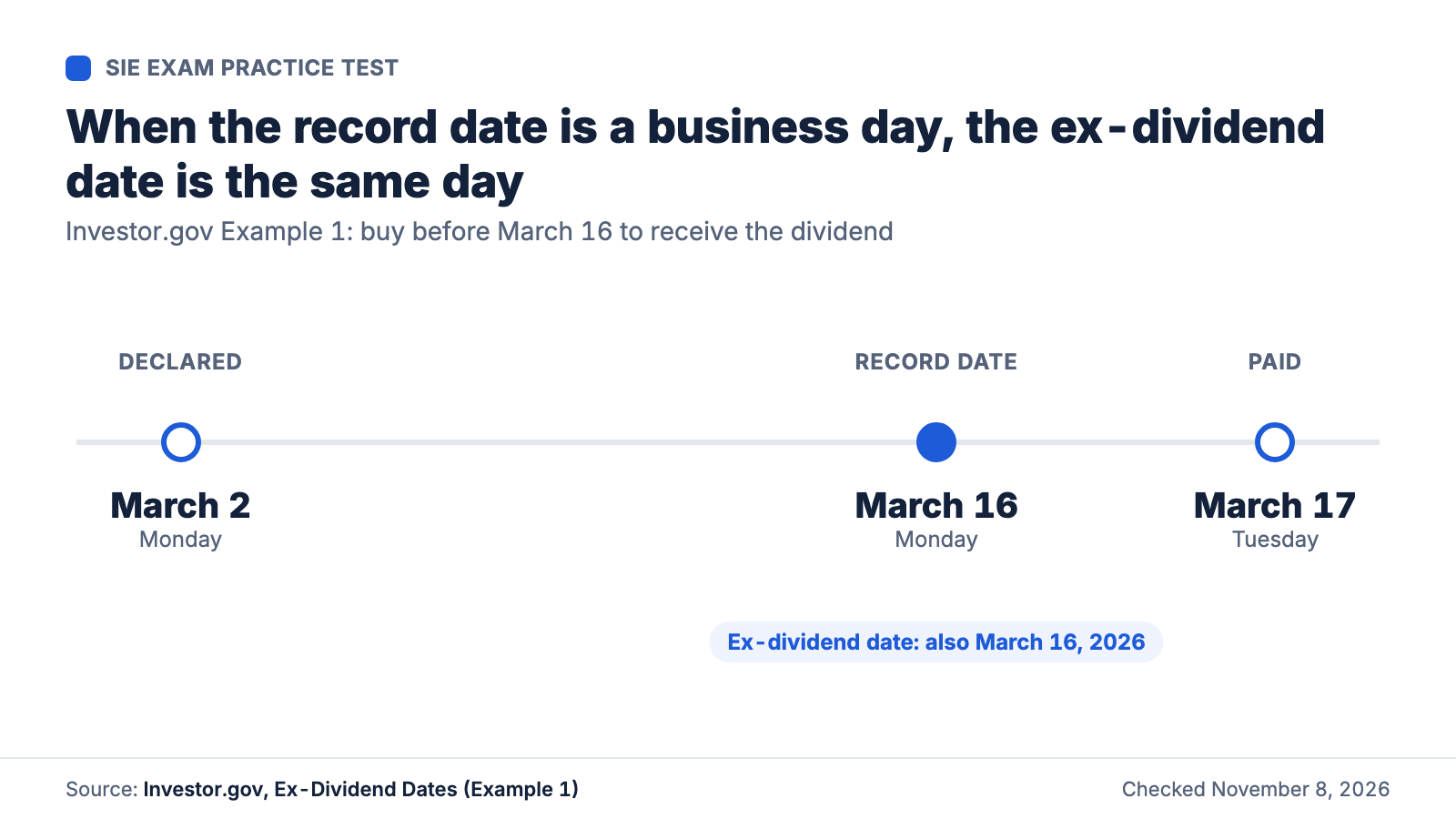
Example: Company XYZ declares a dividend on Monday, March 2, 2026, payable on March 17, to shareholders of record on Monday, March 16. Because March 16 is a business day, the ex-dividend date is also March 16. Buy on March 13 and you get the dividend. Buy on March 16 and the seller gets it.
Often confused with: the record date. The company sets the record date to decide who is on its books as a shareholder. The ex-dividend date is then set from that under stock exchange rules.
Investor.gov: "If you purchase a stock on its ex-dividend date or after, you will not receive the next dividend payment. Instead, the seller gets the dividend." Ex-Dividend Dates. Checked October 24, 2026.
Outline topic 3.1.2 (record, ex-dividend and payable dates). Study it in 3.1.2 investment returns.
Best Execution
Best execution is a broker-dealer's duty to use reasonable diligence to find the best market for a customer's order and to execute it so the price is as favorable as possible under prevailing market conditions. FINRA's best execution rule is Rule 5310. MSRB Rule G-18 is the best execution rule for municipal securities.
Example: A firm routes customer orders to one venue and never reviews the execution quality it gets. FINRA's Sanction Guidelines list a failure to "conduct reasonable regular and rigorous or order-by-order reviews of execution quality" as a factor in best execution cases.
Often confused with: getting the single best price on every order. The SEC's Market 2000 study explains that price is the main factor but that brokers have not been held to an absolute requirement of the most favorable price on each order. The duty is to use due diligence to get the best execution possible given all the facts and circumstances.
FINRA (NASD) disciplinary action wording: "failed to use reasonable diligence to ascertain the best inter-dealer market, and failed to buy or sell in such market so that the resultant price to its customer was as favorable as possible under prevailing market conditions." FINRA disciplinary actions, August 2002. Checked November 4, 2026.
Sources: FINRA Sanction Guidelines (checked November 5, 2026), SEC Market 2000, Study V and MSRB Rule G-15 (checked October 24, 2026). Outline Section 3 rule list (FINRA 5310). Study it in 3.1.1 orders and trade capacity.
Accounts, Tax & Retirement
This group covers the account types and registrations in outline topics 3.2.1 and 3.2.2, plus the yearly limits for retirement and education accounts. The dollar limits below are for 2026.
| Term | Plain definition or 2026 limit | Source |
|---|---|---|
| Cash account | You pay the full amount for securities you buy. You cannot borrow from the broker-dealer. Regulation T governs it. | Investor.gov |
| IRA contribution limit | $7,500, plus a $1,100 catch-up if you are 50 or older | IRS |
| 401(k) elective deferral | $24,500, plus an $8,000 catch-up at 50 or older ($11,250 at ages 60 to 63) | IRS |
| Coverdell education savings account | $2,000 per beneficiary per year, across all Coverdell accounts | IRS Topic 310 |
| Required minimum distribution | Withdrawals generally start at age 73 (see the RMD entry) | IRS |
Example: You are 52 in 2026. You can contribute up to $8,600 to your IRAs for the year: the $7,500 limit plus the $1,100 catch-up.
Often confused with: the IRA and 401(k) limits. They are separate limits with separate catch-up amounts.
Checked October 24, 2026. Outline topics 3.2.1 and 3.2.2. Study them in 3.2.2 customer account registrations.
Margin Account
A margin account is a brokerage account in which the broker-dealer lends you cash, using the account as collateral, to buy securities. Margin increases your buying power and also exposes you to larger losses.
| Margin rule | Requirement | Source |
|---|---|---|
| Initial margin, Regulation T | 50% of the current market value of the security | 12 CFR 220.12 |
| Maintenance margin, long positions | 25% of the current market value of all margin securities | FINRA Rule 4210 |
| Minimum equity | At least $2,000, though cash need not exceed the cost of the security bought | FINRA Rule 4210 |
| Margin call deadline | Within one payment period after the deficiency is created or increased | 12 CFR 220.4 |
Example: You buy $10,000 of stock in a margin account. Regulation T requires you to deposit at least $5,000 (50%), and the broker-dealer lends the rest.
Often confused with: a cash account, where you must pay in full and cannot borrow. FINRA's intraday margin standards replaced the $25,000 pattern day trader rule, effective June 4, 2026, with a phase-in period ending October 20, 2027 (Regulatory Notice 26-10).
Investor.gov: "A 'margin account' is a type of brokerage account in which the broker-dealer lends the investor cash, using the account as collateral, to purchase securities." Margin Account. Checked October 24, 2026.
Outline topic 3.2.1. Study it in 3.2.1 account types.
Required Minimum Distribution (RMD)
A required minimum distribution (RMD) is the minimum amount you must withdraw each year from a traditional, SEP or SIMPLE IRA or an employer retirement plan once you reach age 73. You can withdraw more than the minimum. Withdrawals are taxable income, except any part that was taxed before (your basis) or that can be received tax-free.
Example: You reach age 73 in 2026. Your first IRA RMD is due by April 1, 2027, which is April 1 of the year after the year you reach 73. For a 401(k), the first RMD is generally due April 1 after the later of reaching 73 or retiring, if the plan allows the delay.
Often confused with: Roth IRAs. You are not required to take withdrawals from a Roth IRA while you, the owner, are alive. Roth IRA beneficiaries are subject to the RMD rules.
IRS: "Your RMD is the minimum amount you must withdraw from your account each year." Retirement topics: RMDs. Checked October 24, 2026.
Outline topic 3.2.2 (required minimum distributions). Study it in 3.2.2 retirement accounts.
Freeriding
Freeriding is buying a security in a cash account and selling it before you have paid for it. Regulation T does not permit it, and the broker may freeze your cash account for 90 days.
Example: You buy shares in a cash account on Monday and sell them on Tuesday without ever paying for the purchase. Your broker may freeze the account. For the next 90 days you can still buy securities in that account, but you must pay in full on the trade date.
Often confused with: margin trading. In a margin account the broker-dealer lends you money to buy. In a cash account you must pay for each purchase before you sell it.
Investor.gov: "If an investor buys and sells a security before paying for it, the investor is 'freeriding' which is not permitted under the Federal Reserve Board's Regulation T and may require the investor's broker to 'freeze' the investor's cash account for 90 days." Freeriding. Checked October 24, 2026.
Outline topic 3.3.1 (market manipulation and prohibited trading). Study it in 3.3.1 market manipulation.
Material Nonpublic Information (MNPI)
Material nonpublic information (MNPI) is significant information about a security or its issuer that has not been made public. Trading on it in breach of a duty of trust or confidence is illegal insider trading. Passing it on ("tipping"), trading by the person tipped, and trading on misappropriated information can also violate the law.
Information is material if there is a substantial likelihood that a reasonable person would consider it important. SEC staff guidance states the test this way and traces it to two Supreme Court cases, TSC Industries v. Northway (1976) and Basic Inc. v. Levinson (1988). Under them, a fact is material if a reasonable investor would view it as significantly altering the "total mix" of information available.
Example: An employee of a printing firm prints merger documents for a company and buys that company's stock before the deal is announced. Investor.gov lists employees of law, banking, brokerage and printing firms among the people the SEC has charged in insider trading cases. The SIE outline lists the penalties as fines, expulsion and incarceration.
Often confused with: front running. FINRA Rule 5270 bars trading while holding material, non-public market information about an imminent block transaction, before that information is public. Front running under Rule 5270 turns on information about a pending block trade.
Investor.gov: "Illegal insider trading refers generally to buying or selling a security, in breach of a fiduciary duty or other relationship of trust and confidence, on the basis of material, nonpublic information about the security." Insider Trading. Checked October 24, 2026.
SEC Staff Accounting Bulletin No. 99: "A matter is 'material' if there is a substantial likelihood that a reasonable person would consider it important." sec.gov. Checked November 8, 2026.
Source: FINRA Rule 5270, checked October 24, 2026. Outline topic 3.3.2. Study it in 3.3.2 insider trading.
Outline Section 4: Overview of the Regulatory Framework (9%, 7 scored items)
Compliance & Conduct
This group covers the registration filings, reporting deadlines and anti-money-laundering reports that apply to registered persons and their firms. These terms come from outline topics 4.1 and 4.2, with the AML reports from 3.2.3.
| Term | Plain definition or deadline | Source |
|---|---|---|
| Form U4 | Registration application for an individual. Amend it no later than 30 days after learning the facts that require the change. | FINRA By-Laws Article V |
| Form U5 | Termination notice. File within 30 days of the individual's employment end date. | FINRA Form U5 |
| Currency transaction report (CTR) | Filed for a transaction in currency of more than $10,000 | 31 CFR 1010.311 |
| Suspicious activity report (SAR) | A broker-dealer files one for suspicious transactions involving at least $5,000 | 31 CFR 1023.320 |
| Account statement | Sent to customers at least once every calendar quarter | FINRA Rule 2231 |
| Regulatory Element CE | Completed annually by December 31 | FINRA Rule 1240 |
Example: A representative's employment ends on June 1. The firm must submit Form U5 within 30 days, so by July 1.
Often confused with: the CTR and SAR thresholds. A CTR is about cash over $10,000. A SAR is about suspicious activity of at least $5,000, in any form of funds or assets.
Checked October 24, 2026. Outline topics 4.1.1, 4.2.1 and 3.2.3. Study them in 4.2.1 employee conduct.
CRD Number
A CRD number is the identification number a firm or an individual has in the Central Registration Depository (CRD), the FINRA-run system for licensing and registering securities firms and professionals. Form U4 asks for both the individual's CRD number and the firm's CRD number.
Example: If you or your firm contact Prometric about an exam appointment, Prometric needs your FINRA ID number: your CRD number or an assigned "T" or "U" ID.
Often confused with: BrokerCheck. CRD is the registration system. BrokerCheck is how FINRA releases information to the public about current and former firms and their associated persons, under FINRA Rule 8312.
Investor.gov: "The Financial Industry Regulatory Authority (FINRA) administers the CRD program, which facilitates the licensing and registration of U.S. securities industry firms and professionals." Glossary: C. Checked October 24, 2026.
Sources: FINRA, Schedule an Exam and FINRA Rule 8312 (checked October 24, 2026), and Form U4 (checked November 5, 2026). Outline topic 4.1.1. Study it in 4.1.1 registration and continuing education.
FINRA Rule 3220 Gift Limit
FINRA Rule 3220 limits gifts to $300 per person per year when the gift relates to the business of the recipient's employer. FINRA raised the limit from $100 to $300 effective March 30, 2026, and made the same change in Rules 2310, 2320, 2341 and 5110.
Example: In March you send a $200 gift to a trader at an institutional client. In November you want to send the same trader another $150 gift. The total would be $350, which is over the $300 limit for that person for the year.
Often confused with: MSRB limits. Under MSRB Rule G-20 the earlier $100 limit still applies to municipal advisors and to dealers that are not FINRA members (bank dealers) until December 1, 2026, unless they elect the new limit early. MSRB Rule G-37 is a separate rule on political contributions, with a $250 per-election limit.
FINRA Rule 3220(a): "No member or person associated with a member shall, directly or indirectly, give or permit to be given anything of value, including gratuities, in excess of $300 per individual per year to any person, principal, proprietor, employee, agent or representative of another person where such payment or gratuity is in relation to the business of the employer of the recipient." Rule 3220. Checked October 24, 2026.
Sources: FINRA Regulatory Notice 26-05, MSRB Rule G-20 and MSRB Rule G-37, checked October 24, 2026. Outline topic 4.2.2 (gift, gratuity and non-cash compensation limits). Study it in 4.2.2 reportable events.